Scenes From Gibson Park

If I didn’t know the context behind Gibson Park, I would figure it to be an interesting place with creative yet seemingly senseless public art. Nothing is senseless, however, and I am well aware of its context. There were a few discoveries to be had – even a poetic display about discovery and exploration themselves.

Approaching the park from Beecroft, I see a random horse next to a pole with rings attached to it. This is Stephen Cruise’s 1998 One Hundred Links — One Chain. Several rocks populate its base while a couple of bushes – sadly succumbing to winter – accompany it at either side. I nearly miss the name of the park behind it.

Gibson Park One Hundred Links - One Chain

Of course, the rhyme and the reason lie in the park’s namesake – Mr. David Gibson – whose former Georgian-style residence (now a City of Toronto museum) rests nearby. Gibson was a land surveyor in the 19th century; the post with the trinkets represents his tools of the trade. The rocks aren’t just rocks either. A closer look produces geographic and UTM coordinates for the park. Pretty cool, eh?

Gibson Park One Hundred Links - One Chain

The horse? Well, that’s a reference to an archival photo of Gibson House taken of granddaughter Eva Gibson in a now lost path of the home.

Eva Gibson and Logo (Gibson House Museum).
Eva Gibson with Logo, circa 1905. Source: Gibson House Museum.

Traveling around the display, I see an ample amount of seating and chess tables. I have yet to see anyone play a game in public at any location. I think about doing it myself sometime…and then realize they would be pretty short contests because I am terrible.

Gibson Park Chess Tables

The parkette area is very nicely designed, and nearly makes me neglect the adjoining green space. It is a decently sized lot, but the construction wall at its eastern fringe has me considering the ‘City Within A Park’ motto yet again. More specifically, I doubt whether to even call this a ‘natural space’. Beyond the barrier, a tower rises above Gibson Park. There are a bunch of them springing up around the area as a whole. If I look hard enough into the distance, I can barely make out Gibson House.

Gibson Park (2)
I circle back, wanting to look at the art display again. In doing so, I cross perhaps the neatest  and unexpected installation I’ve seen in Toronto. I see a poem spread across five planks. They read:

“We shall not cease from exploration
and the end of all our exploring
will be to arrive where we started
and know the place for the first time.”
‘Little Gigging’ Four Quarters
-T.S. Eliot

T.S. Eliot Gibson Park (1)

T.S. Eliot Gibson Park (2)

T.S. Eliot Gibson Park (3)

T.S. Eliot Gibson Park (4)

T.S. Eliot Gibson Park (5)
I sit down to ponder everything amazing about this find. The work of T.S. Eliot – one of the great literary communicators – finding itself into this little park in North York. And talking about exploration no less! What kind of exploration? I’m not sure. The city wanderer in me takes it as literal at first, but perhaps there’s something more symbolic to it. That is to say, life is an exploratory sequence of happenings – taking us from us from place to place and experience to experience. Perhaps when we circle back to our roots and to the core of who we are (were?) at the start of it all, would we recognize ourselves and everything?

Update: In 2015, the Gibson Square condo development by Menkes Developments finally wrapped up. The result was a completed, redeveloped Gibson Park, which opened in May 2015.

Gibson Park 2
The path to getting the Gibson Square Condos involved a Ontario Municipal Board challenge by Toronto City Council. Menkes won. To gain approval for their project, the developer also agreed to redo Gibson Park. The company turned over ownership of the park to the City of Toronto, but it handles all maintenance.

Gibson Park 3

Gibson Park 4

Worked into the park is neat granite mural which pays tribute to the Gibsons. It features Eva Gibson and Logo too.

Gibson Park mural 2

Gibson Park mural
Over on Yonge Street, the towers loom above Gibson Square. In the middle of the space is a Tolman Sweet Apple Tree, the last tree connect to the Gibsons’ historic apple orchard.

Gibson Square

Tolman Sweet Apple tree
Gibson House Museum

Related Links

Inside Toronto Beach Mirror – “NATURAL ROOTS: The Tolman sweet apple at Yonge and Sheppard is the last tree from David Gibson’s orchard” by Edith  George

Toronto Star – “Gibson Square revives historical spirit of North York” by Tracy Hanes

Sam The Record Man Sign Belongs in a Yonge Street Museum

Sam the Record Man Sign
Credit: Shane S. Flickr stream

I have never stepped inside Sam the Record Man, and I shamefully admit my memories of walking by the famous neon signs at Yonge and Gould are vague at best. My experience is limited to exploring my father’s record collection which he purchased at the store in the 80s, and sifting through what would be become new favourites like Bowie’s Let’s Dance and the Saturday Night Fever soundtrack. With this said, personal memory and collective memory are separate yet connected ideas, and while my own past does not directly intersect with the life and times of Sam the Record Man, I feel part of a collective whose past indeed does – even if those memories aren’t mine.

The issue to me is not losing the store itself. Business is a tricky endeavour, and recent high-profile examples unfortunately show that even the most profitable and high profile enterprises can fold. There are many that would like to see it in existence, and I am not diminishing those sentiments. But since it is gone, we are faced with a ‘now what?’ situation.

Well, the ‘now what?’ is what do we do with the giant neon signs. The signs are the most tangible remnants of that store, along with perhaps the records purchased from the record shop that still exist in the collections of its former patrons and the auctioned memorabilia distributed in the store’s final days. The issue is commemorating, through the signs, the importance of Sam’s and its owner Sam Sniderman in the narrative of our music and cultural history.

Many assign Ryerson University – a rapidly expanding institution and the current owners of the former site of the store – as the villains in this saga. Many lament the loss of the Yonge Street Entertainment Strip (located between Queen and Gerrard Streets), of which Sam’s was a big part of, and dismiss its current incarnation as a soulless commercial and educational strip filled with an upcoming Ryerson student buildings and a mix of big and small name shopping destinations.

Sam The Record Man, Steeles Tavern, A&A
A&A, Steeles Tavern, & Sam The Record Man ca. 1971
         City of Toronto Archives           Series 1465, File 312, Item 51

For me, times change and there should be no qualms about new epochs coming into fashion. That’s fine. The fascinating thing about Toronto is its layered history. Different occupants, one after another (or sometimes at the same time), move into an area, set up their establishments, and in doing so they transform the character of their locale. This is perhaps no better manifested than in Kensington Market.

As these transformational processes take place and time, the altered urban landscapes have the power to reveal and conceal the layered history of their use. From the 1960s to about the 1990s, The Yonge Street Strip was for the most part a music and entertainment epicentre in Toronto. The sites which have contributed to this characterization have largely disappeared. Some buildings currently employ different uses (like Friars Taven at Dundas), others have been demolished completely (like the Colonial Tavern at 203 Yonge St). The loss of Sam’s and the Empress Hotel (which has quite the history itself) were the latest in this episode. The only visible reminder is Zanzibar’s, although even that has shifted identities from a music club to a purely adult entertainment establishment. Take this further and one hundred years ago the history of the Yonge Street Strip comes a bit full circle with how we might see it today. In 1912, for example, Sam’s was Curtis-Wilson Furniture Co. and Byers Albert Jefferies, Ltd., furries. 349 Yonge – Steeles Tavern, which Sam Sniderman eventually took over – was Hele’s Ceramic Art. Co. A&A at 351 Yonge was owned by Walker Frank, a man in the clothing business. In other words, this was a retail strip in its own right.

SamsDirectory1912

Today, the site of Sam is occupied and owned by Ryerson Univeraity – a booming educational institution that has seen tremendous growth since its days as a polytechnic. One has to guess that growing levels of enrollment within existing programs and the addition of new programs has necessitated its spatial growth, so as much as we might curse the ‘takeover’, perhaps we cannot fault that from occurring.

So the question remains: where do the signs end up? They are doing no favours to anyone stored in a North Toronto trailer.

The original plan was to have them mounted within the new student centre as a part of the deal struck by the Ryerson-Sniderman deal. Much fuss has been made about a broken promise on Ryerson’s president who has said that signs would clash with the modernist style of the new building.

Recently renewed talk has called for the need of a Toronto Museum. Whether we have the site and leadership to finally execute such a needed endeavour is another story. It does remain, however, that the neon signs would be ideal artefacts within such as a space. This would help in telling the musical and cultural narrative of Toronto as well as the role of Yonge Street.

Ideally, I’d like to see them back a part of the street, which also was the proposal put forward by Councillor Wong-Tam and supported by Mayor Rob Ford. The signs are best preserved and presented in context. Sam’s was an important part of a certain era of Yonge Street, and its signs should be displayed at its historic intersection. In doing so, in the end, we are putting them in a museum – albeit one that lacks physical plant and invites the components of the urban landscape to be the artifacts themselves.

Urban landscapes as museums are not a new idea. The Textile Museum’s mobile app TXTile City turns the city of Toronto into a museum whose artifacts are the sites – the built forms and their related oral histories — themselves. A recent TedTalk promoted the idea of the built and natural forms of Indianapolis – the city itself – as a science museum. A Toronto Star column has outlined the importance of Yonge Street. This is our Saint Laurent Boulevard of Montreal fame. Like The Main, Yonge Street, our spine, bisects the city, connects neighbourhoods, serves as cultural and commercial epicentre, and has a very layered past. In other words, it is important in the historical, geographic, cultural, natural, economic, sociological development of Toronto.

Fortunately, we already have something like what I’ve been proposing already underway. Youryongestreet is an online crowdsourcing initiative, launched by the Toronto Public Library, aimed at celebrating the history of Yonge Street. The potential age range of participants (and backgrounds in general) allows for exactly what I’ve been talking about: the presentation of the diversity of Yonge Street. The exhibits collection features a range of images, videos, audio accounts, and written tales about Yonge Street.

Youryongestreet and the urban landscape museum I have presented are two parts in an grander museum that showcases Yonge Street’s past. No doubt the Sam the Record sign should be an artefect in that museum, too.

Scenes From The Elgin and Winter Garden Theatre Centre

The Elgin and Winter Garden Theatre Centre is a very intriguing Toronto landmark. In addition to being perhaps the only double-decker theatre left on the continent, it is also  a National Historic Site (NHS) as of 1982, making it a cultural icon on a national level. Beyond its significance as a modern performing arts centre and a movie house before that, it houses the greatest collection of 1920s Vaudeville props and sets.

Photo Credit: Ontario Heritage Trust

Unlike most National Historic Sites which have undergone adaptive reuse as museums (Fort York) or commercial establishments (The Distillery District), the Elgin and Winter Garden continues to be a fully functional, money making enterprise. This presents an interesting situation because as a NHS it must protect, promote, and manage the heritage values – while also existing as a living venue whose primary goal is to put on productions and attract paying visitors.

Lobby
Corridor leading from the main doors
Staircase
The Grand Staircase

Hall

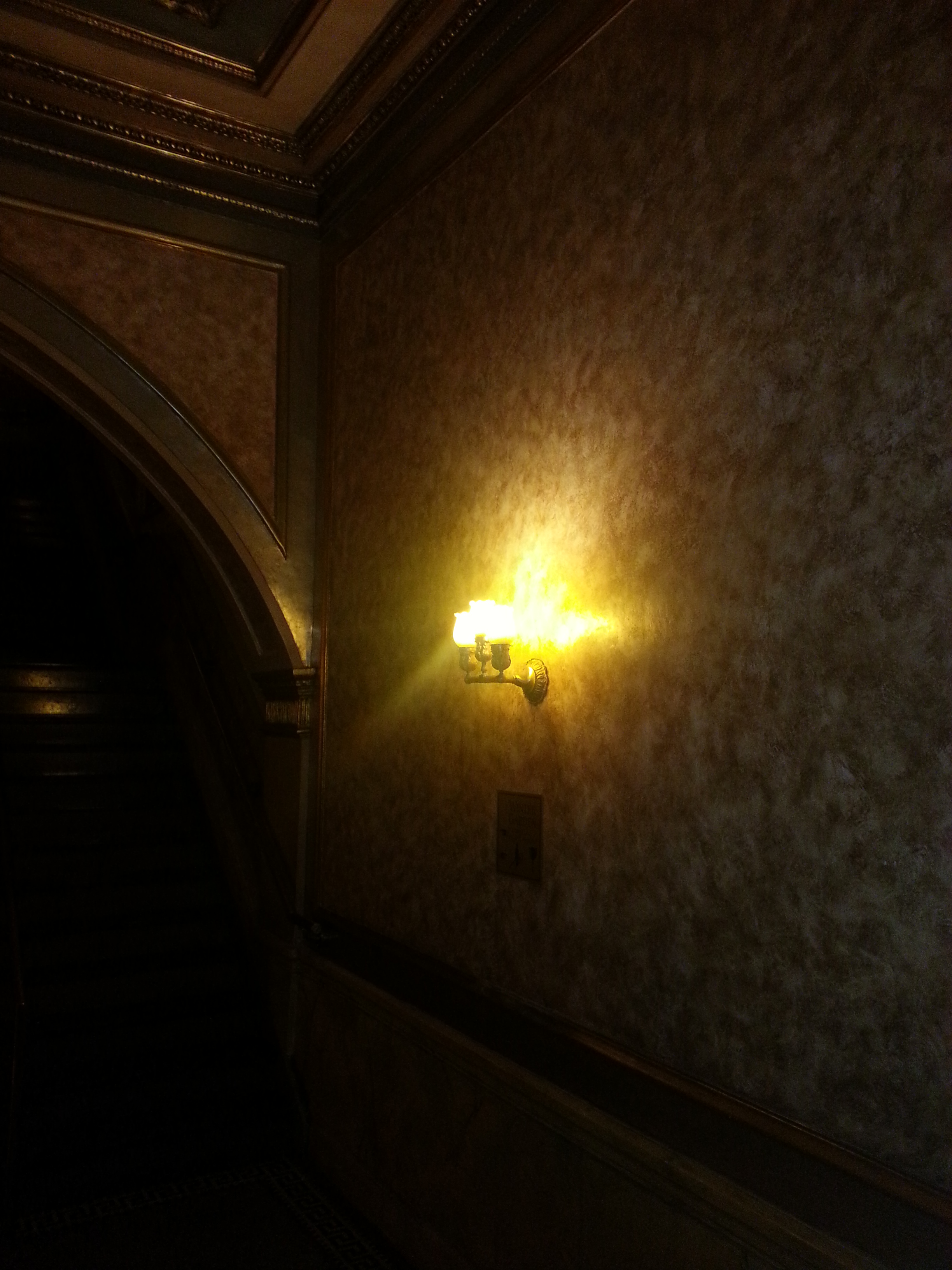
The Centre was designed with allure of grandeur. The ornamental gold on the walls and the marble columns are just that – finishes. Being at the Centre is as much about witnessing a spectacle inside the theatres themselves as much as it outside of them.

Managing the heritage aspects of the theatres while trying to keep it operational I learned is a tough task if only because one encounters heritage everywhere. I found out that it is about finding a middle ground, a compromise – being the least invasive. Often this involves creative solutions to issues.

The Elgin Theatre
The Elgin Theatre
The Winter Garden Theatre

The Winter Garden Theatre was closed in 1928, which left it in a time capsule until the Ontario Heritage Trust rescued and restored both theatres in 1981. The walls, which had taken 50 years of dirt, had to be cleaned with bread dough so as to not disturb the designs underneath. The leaves hanging from the ceiling (barely visible in the darkened picture) had to be made fire proof because they are otherwise a hazard.

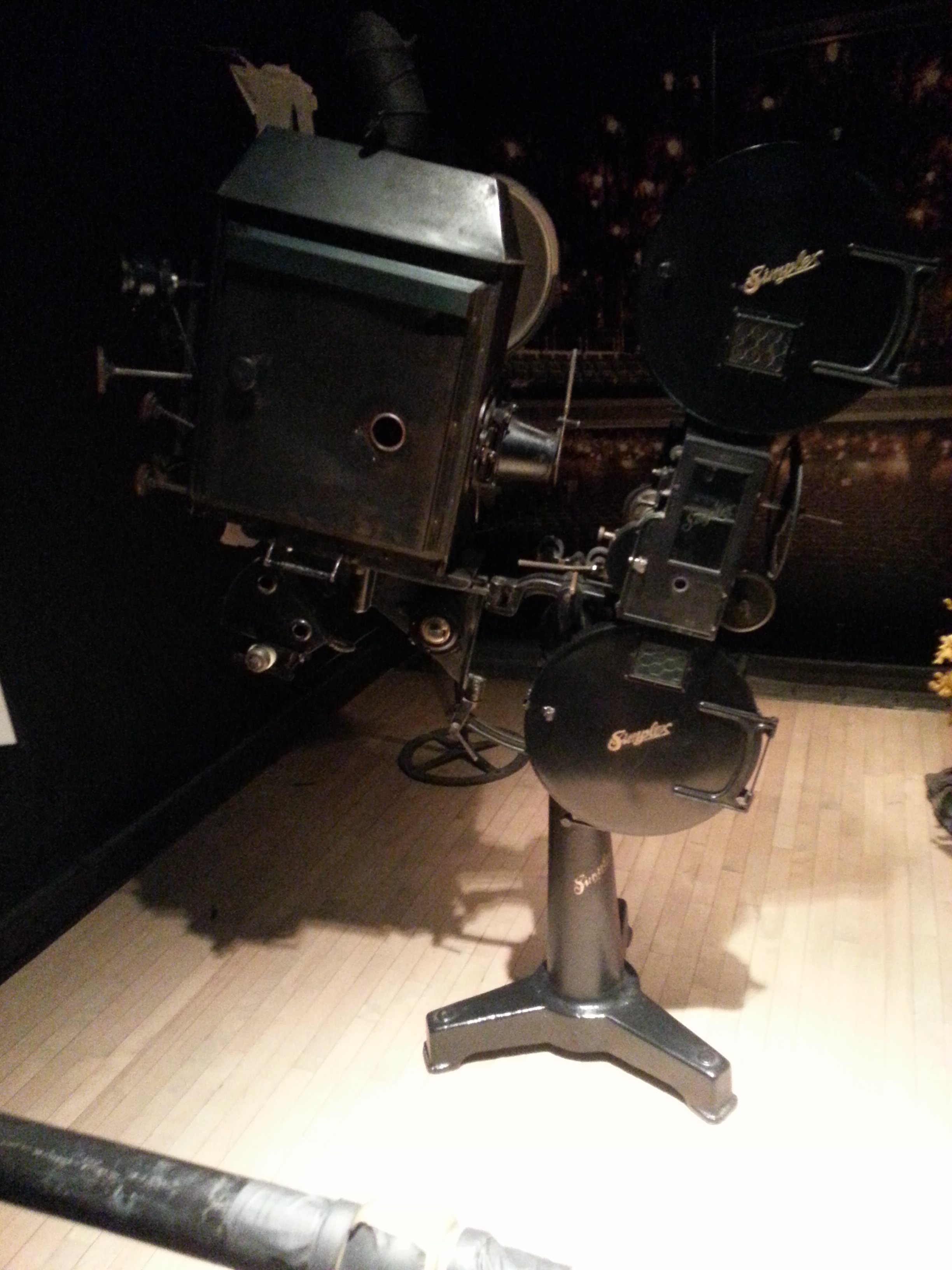
Old Camera

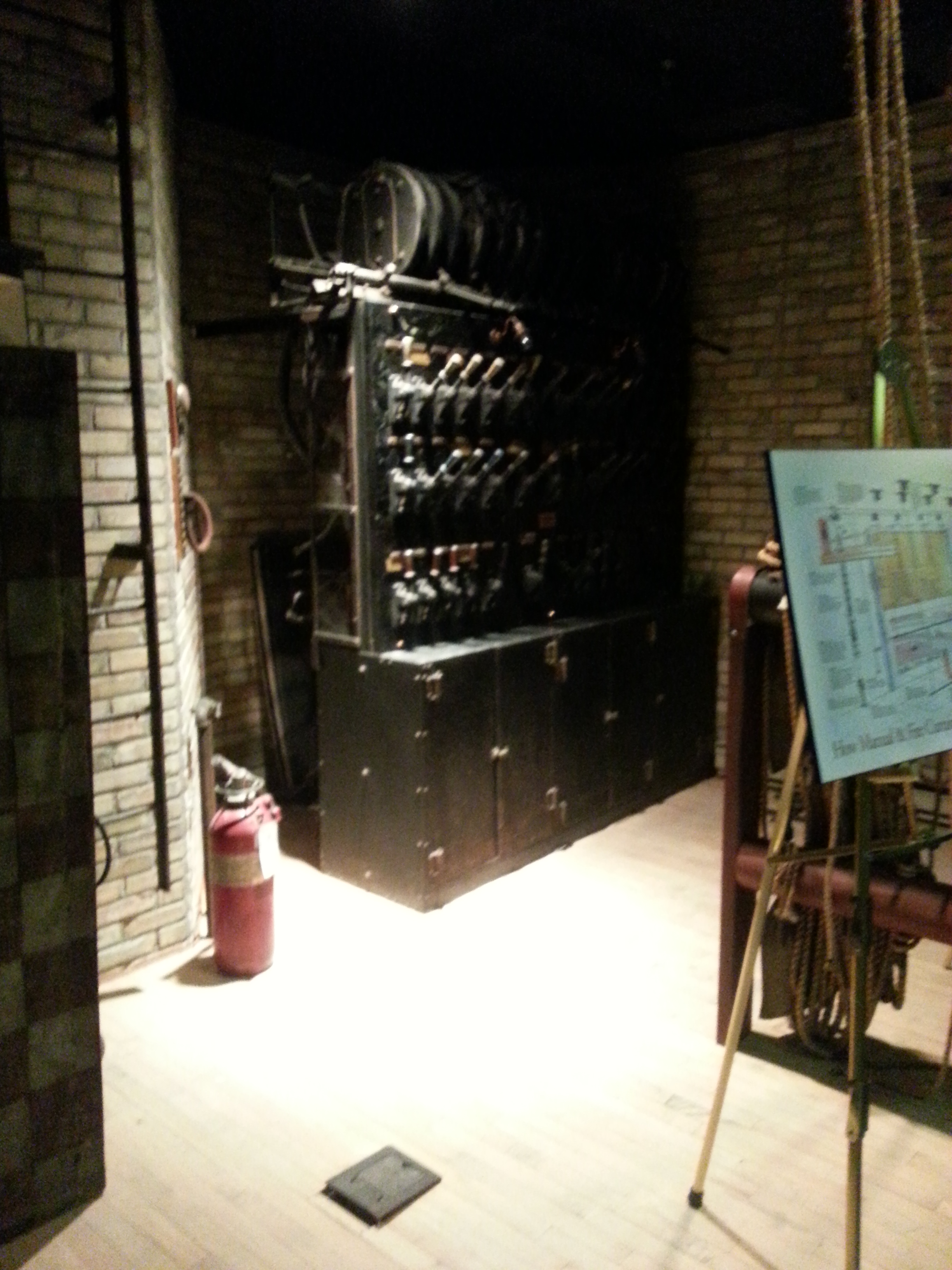
Old Panel Exhibit

Exhibits
Perhaps the most famous production in the Centre’s history
Model of the Theatre

The theatres have museum-like elements with a number of exhibits including the original camera and electrical panel backstage and information on the famed shows (including the wildly successful “Cats”) that have graced its stages. Notable  is a detailed model of the entire complex. It’s fun to note that the theatres themselves were built to front onto Victoria Street because real estate was more highly priced on Yonge Street (like it is today). With the 100th anniversary of the Elgin Theatre this year, there have been more opportunities to showcase its animated history.

Special thanks to The Architectural Conservancy of Ontario‘s Next Gen group for allowing this inside look. They allowed me pleasure of shadowing the General Manager, Brett Randall, as well as some of his staff at the Elgin and Winter Garden Theatre National Historic Site. The multi-perspective insight on how to run a heritage site and a performing arts venue was a treat.