When Taddle Creek stank: Why the river was lost

Note: This article first appeared in Spacing Magazine, Issue 56. It has been reproduced here with permission.

In the late nineteenth century, Taddle Creek between Bloor and College Streets was a risk to public health. The waterway was then known as University Creek, since it passed through the grounds of the recently formed University of Toronto. It was considered a nuisance by everyone who commented on the unpleasant situation.

Once part of a picturesque natural landscape, by 1873 the state of University Creek had begun to decline, and it worsened over the next decade. Although arguably not the filthiest waterway in Toronto at the time (the Don River or Garrison Creek may have taken that title), the stream was essentially an open sewer.

Watercolour by Lucius O’Brien entitled University College, showing McCaul’s Pond on Taddle Creek, 1876. Credit: University of Toronto Archives.

The cause of the filth was sewage flowing from the nearby Village of Yorkville. The Toronto suburb was its own independent political entity at the time and, in the 1870s, its water supply and drainage were proving inadequate. Consequently, residents on Prince Arthur, Elgin, and Lowther Avenues, as well as on the north side of Bloor Street West, discharged their waste directly into the creek. There were also reports that McMaster College (now the Royal Conservatory) draining “refuse water from the sinks and water closets”  into the stream as well. 

Citizens called on the University of Toronto and City of Toronto to close the creek and hold Yorkville accountable, but little was accomplished.

And so, University Creek stank. McCaul’s Pond – the connected man-made pond named for the school’s first president – was a cesspool. Winds carried the stench as far north as Bloor Street, south to College Street, west to St. George Street, and east to North Street (now part of Bay Street). Above all, the University Creek nuisance posed a danger to the well-being of the approximately six hundred students and faculty at the University, the residents living around Queen’s Park, and visitors to the park.

University of Toronto Campus Map of area bounded by College, St. George, Bloor and Surrey Place, 1859. Credit: University of Toronto Archives.

The mismanagement of University Creek had consequences for the health of Torontonians. According to The Globe, dwellers close to the waterway had become “accustomed” to the odour, but their sense of smell had been “deadened” as if they were working in a “soap boiling factory.” A former alderman of the city was said to have been “laid up” by an unspecified illness caused by the creek. 

Ultimately, however, an even greater fear grew out of the University Creek debacle. The impacts of wide-spreading diseases like cholera were well-known in Toronto by this time.  The Town of York had experienced a bout of cholera in 1832, which took the lives of several hundred  residents from a total population of 5,000. Two years later, another epidemic of the same kind hit what was by then the City of Toronto. These events led to greater awareness of sanitation and the creation of a municipal public health board. When Dr. John Snow uncovered the disease’s water-born roots in England in the 1850s, Toronto was, in theory, better placed to understand and respond to the disease.

McCaul’s Pond, present site of Hart House, circa 1880. Credit: University of Toronto Archives.

But a cholera outbreak swept through Europe and Egypt beginning in 1881. By 1883, the outcry over the state of Toronto’s waterways and the tangible possibility of an epidemic heightened concerns even more. At least two news articles unceremoniously likened University Creek to the ”River Styx” of Greek mythology. Another commentator argued in The Globe that cholera resulting from the stream would have been a ”blessing in disguise” as it would have spurred officials into action after a decade of inertia. 

In 1883, public health reports on University Creek finally spurred action. Toronto’s medical health officer in commenting on the state of the polluted stream and its ”effluvia,” suggested the only effectual remedy was the construction of a sewer and, in the short term, the use of ”disinfectants.” In an interview with The Globe, Dr. John Oldright of the Provincial Board of Health echoed those recommendations. With that, the matter was turned over to the Board of Works, which solicited tenders for a University Creek sewer. The City Treasurer quoted a total cost of $11,200. 

In 1884, the City Engineer received orders to proceed with the project, and the stream was encased underground. By May, the southern section of the University Creek sewer was completed first, connecting it to the existing Murray Street sewer. This portion ran through the grounds of “Sleepy Hollow”, the estate of Lieutenant-Governor John Beverley Robinson, on the south side of College Street between University Avenue and McCaul Street, “so that surplus water that may collect at the approach will be carried away”. The northern section was completed later that year. 

Hering & Gray: Plan of the City of Toronto, Proposed Intercepting Sewers and Outfall, 1889. Credit: Fort York and Garrison Common Maps

Just as University Creek disappeared underground, references to the waterway’s name faded in the decades following the construction of the new sewer. Today, Taddle Creek – the common name for the stream since about the 1920s — lives on in the legends of lost Toronto. The ravine-like landscape of Philosopher’s Walk hides the north end of University Creek while Hart House and Hart House Circle sit over the former McCaul’s Pond. With some recent calls to daylight this portion of Taddle Creek, perhaps one day this long-buried creek may live again, only now, its fresh, clean water will be a public health benefit rather than a curse. 

Scenes From Mono Cliffs Provincial Park

Mono Cliffs Provincial Park is located about 15km north of Orangeville, Ontario. Established as a park in the 1970s, the area is a mixed landscape of plains, hills, lakes, old-growth forest, and of course, tall rock formations. It is also part of the Bruce Trail, which stretches between the Niagara Region and the Bruce Peninsula.

The path taken on this round-trip was the Carriage Trail, Spillway Trail, Walter Tovell Trail, Cliff-Top Side Trail, and the Carriage Trail once more complete the loop. It is about 5km altogether.

The trails of Mono Cliffs are numerous and multi-use, including horseback riding, hiking, and cycling. The park’s entrance at 3rd Line EHS starts one off with the Carriage Trail. It is a relatively easy hike through fields and forests.

The Spillway Trail continues through much of the same environment, entering a forested area at its north end as it meets the Walter Tovell Trail. From here the trail curls south.

The Cliff-Top Side Trail is the most popular of the Mono Cliffs trails and for good reason. It ascends an incline and eventually reaching the top of the cliffs. A set of wooden stairs takes one into the crevices of the impressive formations.

The Mono Cliffs themselves are part of the Niagara Escarpment, a geological wonder that curves through New York through southwestern Ontario to Illinois. The Niagara Escarpment formed about 450 million years ago.

A topographical map of Mono Cliffs Provincial Park, 2021. Source: Google Maps.

A lookout point marks the second attraction of the Cliff-Top Side Trail, providing an impressive vista.

The trail has interpretative plaques along the way about the built and natural heritage of the Mono Cliffs area. One marker tells the story of the Village of Mono Centre, which one can reach at the southern end of the Cliff-Top Trail. Aboriginal peoples had visited the cliffs and area for thousands of years before the arrival of the Europeans in the 1820s. Mono Centre itself grew from this point, reaching a notable level of activity in the 1850s and 60s.

To descend the escarpment, the Cliff-Top Side Trail meets up with the Carriage Trail which then reaches a long set of wooden stairs, showing off just how pronounced the elevation change is in the Mono Cliffs.

From here, the Carriage Trail returns back to the entrance, completing what is an interesting walk through millions of years of history.

Further Reading

“Heritage & Natural History.” Town of Mono, townofmono.com/about/heritage-natural-history.

“Mono Cliffs Provincial Park Management Plan.” Ontario.ca, http://www.ontario.ca/page/mono-cliffs-provincial-park-management-plan.

“Mono Cliffs.” Welcome to Mono Cliffs Provincial Park, http://www.ontarioparks.com/park/monocliffs.

“The Niagara Escarpment.” The Bruce Trail Conservancy, brucetrail.org/pages/about-us/the-niagara-escarpment.

Scenes From Leaside Spur Trail

Note: The City of Toronto refers to the Don Mills Trail as running from York Mills Road to just north of Eglinton Avenue. Google Maps labels the path north of Bond Park as the Leaside Spur Trail. These two names are generally used interchangeably. As this article will focus on the northern part of the trail, Leaside Spur Trail will be primarily used.

The neatest feature on the Leaside Spur Trail is also the most visible sign of its history. This is an elevated bridge with a narrow tunnel connecting Bond Avenue and the linear parking lot of Bond Park.

The bridge was built in 1912 in preparation for a new railway spur. This line, built by the Canadian Northern Ontario Railway (CNOR), linked two existing railways to the north and south, with the failed idea of moving passengers to North Toronto Station. The spur line also travelled down to the Canadian Northern’s shops on Laird Drive in Leaside, explaining the Leaside name despite being nowhere near that community.

The Canadian Northern Ontario Railway before the Leaside Spur in the Map of the Townships, York, Scarboro, and Etobicoke, 1916. Source: University of Toronto Map and Data Library.

From the Bond Avenue bridge, the spur trail travels parallel to the adjacent Bond Park. The park has existed since at least the 1960s and its triangular footprint is shaped by the two railways. The street and park are named for the Bond family which farmed the area historically. On the other side of the trail are the industries of Scarsdale Road. There are unofficial entries points on both sides.

The Leaside Spur Trail then runs parallel to the existing railway. The path briefly travels under the York Mills overpass with exits points at Scarsdale and the Longos parking lot at York Mills Gardens. Cyclists can continue north through the Lesmill Business Park to the Betty Sutherland Trail and beyond.

The Leaside Spur Line finally opened in 1918, but the CNOR did not operate it. The CNOR folded in that year, and its assets fell to the Canadian National Railway (CNR or CN). The CNR used the right of way to move freight. It ceased operations altogether on the Leslie Spur Line in 1999 and the tracks were subsequently removed.

Leaside Spur Line in The Pleistocene of the Toronto Region, 1932. Source: University of Toronto Map & Data Library
Leaside Spur Line in the Topographical map, Ontario, circa 1942. Source: City of Toronto Archives.

In the early 2000s, the City of Toronto purchased the former Leaside Spur right of way. In 2011, construction began on the Don Mills Trail. The section south of Bond Avenue was completed first. The future of the century-old Bond railway bridge was nearly in question. The section north of Bond Avenue, which before paved was previously a gravel path that dead-ended at a fence where the rail bed once met the CNR line, was finished in 2016 — fortunately with the restored rail bridge intact.

At the north end of the Leaside Spur Trail, there is a great piece of hidden history. For the majority of the 20th century, there was a railway station on the south side of York Mills Road where it met the CN line at a level crossing. Built in 1905, this was Duncan Station (later addressed at 845 York Mills Road). The station was named for the Duncan family. It served the farmers of Oriole and, later, the community of Don Mills. Duncan Station was later redubbed Oriole Station, possibly to avoid confusion with another Duncan Station on the line and to reference to the community to the north at today’s Leslie Street and Sheppard Avenue. For this reason, the Leaside Spur Line was also known as the Duncan Cut-Off and later the Oriole Cut-Off. Oriole Station was a two-storey structure and was notable in that it was a third-class Canadian Northern Railway station typically found in rural Western Canada.

The former Oriole Station in an undated photo, likely the 1960s or 1970s. Source: Toronto Public Library.

By at least the 1950s, Oriole Station was moved away from the tracks and replaced a smaller flag stop. The original station became a private residence. In 1954, the station briefly served as the northern terminus of the new Don Mills bus line during rush hour (permanent service was extended to the area a few years later). In 1970, the York Mills Road Overpass was completed over the railway, replacing the level crossing. Finally, CNR closed Oriole in 1978. In that year, GO transit opened a new transport hub further north on the corridor nearer to the historic location of Oriole at Leslie Street and Highway 401. It was called Oriole GO Station.

The second Oriole Station in 1955. Source: Toronto Public Library.
Toronto Transit Commission System, 1954. Source: Transit Toronto.

In the 1980s, CN intended to demolish the surplus station over safety concerns. By this time, the abandoned station (vacated in 1984) was in a poor state and vandalized several times. In 1985, the North York Historical Board recommended the station to be moved to Moatfield Park at Lesmill Road and Leslie Street, restored, and then repurposed to a soccer clubhouse. Unfortunately, North York Council did not like the $100,000 price tag. The interest in saving the building lay in the former station being the oldest remaining railway station in North York and the last remaining third-class CNOR station in Ontario.

Reprieves and deferrals were granted in 1986, delaying the demolition while a solution could be found. CN was reported to be willing to lease the land to North York (to leave open the possibility of employing the land for future industrial uses) and keep the old Oriole Station in its historic location (albeit moved 20 feet away). At the same time, a North York teachers’ group expressed interest in buying the building and using it in situ as a clubhouse. The agreement was CN was to rent the property to North York for $9,600 a year, who would then sublet to the newly formed North York Railway House Faculty Club for the same price. The only caveat was the faculty club needed to raise a $100,000 letter of credit to cover rental payments if the club went bankrupt. In March 1987, with the teacher’s group unable to secure the financial requirements, North York advised the railway to proceed with demolition. The old Oriole Station was razed shortly after.

No markers or plaques currently stand to honour the Bond Avenue bridge, the Oriole Cut-off/Leaside Spur Line, or the former Oriole Station. They would likely have a decent audience as many walkers, cyclists, and joggers frequent the Leaside Spur Trail today.

The approximate former location of Oriole Station in 2021.

Further Reading

“Don Mills.” Google Books, Google, http://www.google.ca/books/edition/Don_Mills/E_vuCwAAQBAJ?hl=en&gbpv=0.

“Don Mills Trail.” Wikipedia, Wikimedia Foundation, 18 Apr. 2021, en.wikipedia.org/wiki/Don_Mills_Trail.

“Oriole Station.” Toronto Railway Historical Association, 28 Jan. 2021, http://www.trha.ca/trha/history/stations/oriole-station/.

“Toronto’s Lost Villages.” Google Books, Google, http://www.google.ca/books/edition/Toronto_s_Lost_Villages/ummlDwAAQBAJ?hl=en&gbpv=0.

“The Suppression of Intemperance”: 19th Century Coffee Houses in Toronto

Coffee houses are ubiquitous places in Toronto. Tim Horton’s, McCafes, Starbucks, Aroma Espresso Bars, and independent coffee shops seemingly mark every block in its diverse neighbourhoods. While Toronto is in an exciting era of artisanal coffee shops, the locales of the 19th century paint a much different picture in the drink’s social consumption.

Toronto’s First “Coffee Houses”

The first establishment in Toronto to call itself a coffee house was the “Toronto Coffee House”. It was opened in 1801 by William Cooper on the east side of Jarvis Street between King Street and Yonge Street near today’s St. Lawrence Market. Despite the name, historian Chris Bateman writes Cooper’s two-storey establishment was more a tavern than a café, which served liquor, ale, and some food. The name was meant to inspire respectability, drawing on the influence of similarly-named establishments in Great Britain. It also hosted an inn and general store. The coffee house was sold five years after it opened.

In the 1830s, “The (New) British Coffee House” opened in the Chewitt Building at the southeast corner of King Street and York Street. Completed in 1835, the structure was considered Toronto’s first office block. Its ground floor had the Coffee House, which was rented by a Mr. Keating and followed the British tradition in offering a meeting place for influential people. Again, this “Coffee House” likely resembled an establishment serving ale in the British way more than the modern conceptualization of an espresso bar type establishment. 

Chewitt Building, 1835. Source: Toronto Public Library.

In the 1837 directory, the British Coffee House was listed as a “Principal Hotel” as owned by John Cotter. John Grantham’s “Old British Coffee-House” on Front Street was also listed in the category. According to John Ross Robertson, The British Coffee House was closed in 1837 following its role in the meeting of individuals of the rebellion of that year and then seized by the government and used as barracks. By 1843, the Coffee House was listed as a boarding house. By 1850, it had the added moniker of “Club House”, which Robertson stated later developed into today’s “Toronto Club”. The building was torn down for the luxurious Rossin House Hotel in 1862; an office block stands in both their places today.

The City of Toronto and the Home District commercial directory and register with almanack and calendar for 1837. Source: Toronto Public Library.

“Substitutes to Drinking Saloons”

By the mid-19th century, coffee was a known and consumed commodity, albeit there was more to be learned. There seemed to have been some inconsistencies on how the drink was prepared, and apparently a farmer in Scarboro was trying to grow its own specimen of coffee which was conducive to the Canadian climate.

“Pekin Tea Market”, The Globe, November 8, 1858. Source: Globe and Mail Archives.
“Reasons Why Coffee Is So Seldom Well Made”, The Globe, March 20, 1851. Source: Globe and Mail Archives.

But finding coffee in a social setting seemed to have been a rare occurrence. In 1860, a reader of The Globe — an Alexander Somerville — lamented the lack of places for a stranger to find a cup of coffee for a fair price. He found “but one place where a passing stranger can obtain small refreshments, such as one or two cups of coffee at a fair price, at any hour in the day.” This was in Montreal for six-pence. Somerville called on the ‘Sons of Temperance’ to make this happen.

In the late 1870s, the temperance movement used the caffeinated beverage to steer people – mostly men – away from the evils of alcohol. It employed eateries to do so. One of the first coffee houses to open with this purpose in January 1878 was the Albert Street Coffee Room. It was based on the ‘coffee taverns’ and ‘coffee palaces’ established in London and other large global cities.

Albert Coffee Rooms in the City Directory 1879. Source: Toronto Public Library

The Albert Coffee Room at 11-13 Albert Street opened in January 1878, and was funded by social reformer and future Toronto mayor W.H. Howland. It was described as “plainly though nicely fitted up” and containing “the bar, or public room, the billiard room, and the reading room”. All were welcome in the public room where coffee, tea, cocoa, or milk were served “with sandwiches, buns, etc, at certain low yet remunerative prices”. Irish stew was a noted dish too. The other two rooms operated with a small fee and subscription. Profane language and intoxicating liquors were forbidden, although smoking was allowed. Its existence was short-lived, however; by 1881, the Albert Coffee Room closed for unknown reasons.

“Our Coffee Room” at 115-117 York Street at Boulton Street (now Pearl Street) opened in 1879. Its owner was S G Noblett. The establishment was described by a visitor as having a billiard table on the ground floor, all the daily city newspapers downstairs, and a large reading room with a valuable collection of books upstairs. All services are free for visitors, except for the billiard table which is available for “the usual price”. The visitor also boasted the “convenience of being able at any moment to supply one with a cup of hot tea or coffee alone for three cents, or with a buttered roll for five cents”.

Toronto directory for 1879. This was the first year coffee houses were listed in directories. Source: Toronto Public Library.
Toronto directory for 1881. A number of other coffee houses sprang up in Toronto after the success of Our Coffee Room, although possibly not affiliated with the temperance movement. Source: Toronto Public Library.

In the following years, a number of changes came to Our Coffee Room. In 1883, it took on the name of its proprietor and seemingly upgraded from a coffee room to a coffee house. Before it closed in 1886, it was listed as a eating house, abandoning the caffeinated drink altogether in its name.

Toronto directory for 1883. Source: Toronto Public Library.

The impact of these two coffee houses were reported by 1879. In a Globe article highlighting the “Sights of Toronto”, Temperance Coffee-Houses were presented as flourishing establishments with the goals of providing “places of entertainment and substitutes for drinking saloons, where the evil associations of the saloons are absent, and where….coffee and other mild drinks, with lunches ma be obtained with moderate prices”. Both “Albert Street Coffee Room” and “Our Coffee Rooms” were named.

Around this time, the Women’s Christian Temperance Union also operated a coffee house beginning in 1877 on Queen Street West near the Occident Hall at Bathurst Street. The Globe noted that the venture depleted the treasury, and by 1880 it was sold. Later in the decade, the Temperance Union had talks of resurrecting the idea, but it is unclear if it came to fruition.

The Toronto Coffee House Association

The impetus behind the Toronto Coffee House Association may have started in December 1878 meeting of the “Coffee House Committee”. It was held at Shaftesbury Hall on Queen Street at James Street, which was the headquarters of the Young Men’s Christian Association from 1873 to 1887. The committee resolved to make open two coffee houses: one in St. John’s Ward arranged by Howland and others, and another near St. Lawrence Market to accommodate farmers and others in the neighbourhood.

In 1881, the temperance movement formally organized a scheme of coffee houses. In May, there was a “well-attended meeting of parties interested in the prevention and suppression of intemperance” at Shaftesbury Hall. The Committee on Coffee-Houses recommended the formation of a joint stock company and 5,000 shares be issued at once at one dollar per share. The object of the company was “to provide public houses of refreshment and entertainment without intoxicating drink.” The committee highlighted that there were 196 licensed taverns and unknown number of unlicensed places that provided the only places of rest and refreshment. It also targeted working populations, particular men employed in the railways, port, and streetcars, and a separate entrance and room for women. The following passage from The Globe summarizes this philanthropic yet investable endeavour:

“We cannot close our report without stating that, while we wish to launch this Company entirely upoin its merits as a business enterprise, our aim is to benefit the city and promote the cause of temperance, and that we desire he help of all who have at heart the true welfare of our citizens in this good work.”

“Suppression of Intemperance – Meeting in Shaftesbury Hall Yesterday Afternoon – Report on Coffee Houses,” The Globe, May 17, 1881

The organization was inspired by coffee houses in Liverpool run by the British Workman Public House Company, which in the year prior were said to have “a decrease of 1500 in cases of drunkenness.” The goals were to have a collection of strategically located coffee houses targeted towards working men. The capital of the Company was 40 thousand pounds divided in one pound shares. It was reportedly paying out at 14 per cent.

In the fall of 1881, the Toronto Coffee House Association took further steps to organize. It opened a booth at the Toronto Industrial Exhibition where it sold tea, coffee, and other temperance drinks and plain refreshments. It also met to elect a permanent board and decide the location of the coffee houses. They would be located “at the Market-square, another at the corner of Bay and Front streets, and the third in the vicinity of Brock-street.” A meeting of the Society for the Prevent and Suppression of Intolerance urged the participation of society members, particularly in canvassing new members and getting subscriptions. It was also reported that the Coffee House Association had done a number of research into coffee houses in Britain and United States, and interestingly, many people who had taken stock in the organization has never engaged in the temperance cause before.

On November 15, 1881, the first annual meeting of the Toronto Coffee House Association was held at the Confederation Life Association Building. Lieutenant Governor Gzowski served as Chairman for the meeting and was also elected President of the Board of Directors (the Association was operating on a Provisional Board prior to the meeting). It was reported the success of the Liverpool coffee house scheme and that the event at the Exhibition grounds showed that the group could sell a cup of coffee and sandwich for five cents and make a profit.

“Meetings to be Held”, The Globe, November 4, 1881. Source: Globe and Mail Archives.

St. Lawrence and Shaftesbury Coffee Houses

In February 1882, the Toronto Coffee House Association’s inaugurated its first coffee house, the St. Lawrence Coffee House. It was located in the former Small’s Hotel on Jarvis Street at East Market Square. By year’s end, the St. Lawrence Coffee House moved from Jarvis Street to 118 King Street East next to St. James Cathedral, which was a better location.

The first two locations of the St. Lawrence Coffee House in Goad’s Insurance Plan of the City of Toronto, 1889. Source: Goad’s Atlas of the City of Toronto.

The next location to open was across the street from Shaftesbury Hall itself at 23 Queen Street West at James Street. Following the initial plans for coffee house locations, it was at the southern edge of St. John’s Ward, also known as just The Ward – a dense, immigrant enclave, looked upon unfavorably during its time by Toronto’s mainstream establishment for its slum conditions and immoral happenings. Like the St. Lawrence Coffee House at 118 King Street, its capacity was 200 patrons. Interestingly, in March 1889, a man fell through Shaftesbury Coffee House’s coal shoot and successfully sued the Toronto Coffee House Association.

Shaftesbury Hall. Source: Canadian Illustrated News, November 23, 1872.
The locations of the Shaftesbury Coffee House, Shaftesbury Hall, and Albert Coffee Room (closed 1881) in Goad’s Insurance Plan of the City of Toronto, 1889. Source: Goad’s Atlas of the City of Toronto.

In the first annual meeting of the Toronto Coffee House Association, both coffee houses were reported philanthropical and financial successes in their first year. At the second annual meeting of the organization, it was reported that receipts from the year were almost three times as large as the previous year — a total net profit of $1,131.22.

Temperance journals regularly highlighted the successes of the Toronto Coffee House Association. Source: The Coffee Public-House News and Temperance Hotel Journal, October 1, 1886.

In August 1895, The Globe toured through the King Street coffee house, which by 1893 moved from 118 King Street East to a building fronted at 78-80 King Street East and the adjoined 15 Court Street behind it. No reason was given for the move, although the increase in floor space is a possibility. The kitchen, broiling room, and bakery were located on the top floor. On the ground level is the lunch counter and a large, bright and airy general dining hall, where one could get a full-course meal of “two kinds of soup, fish, or one of two meats, with potatoes and vegetables, dessert pudding or pie, coffee, tea or milk” for 20 cents (and an “extra selection” for ten cents more. The next floor was the ladies and gentlemen’s dining room and a large waiting-room. A large lavatory for women flanked the waiting-room with the lower level housing the men’s lavatory. The Globe described the entire establishment as clean and well-ventilated.

Citizens of Toronto can with every confidence their friends to either Shaftesbury Coffee House, 23 Queen Street West; or to the St. Lawrence Coffee House, 78-80 King stret east, and have no fear of having to apologize for any dish served. They are equal to any of this class to be found on the continent. Visitors to the fair should make a note of where these two places are to be found.”

“The Toronto Coffee House Association” The Globe, August 31, 1895.
King St west from Church St, 1927. 78-80 King Street East was just out of the frame on the right side in the Wellington Buildings. Source: City of Toronto Archives.

This description of the St. Lawrence Coffee House is notable for the absence of any reference of the temperance. The purpose seems to promote the establishment as a tourist places for the visitors of The Canadian National Exhibition. Even though it refers to the Coffee House Association’s “Famous Coffee”, the menu likens it to a regular eating establishment.

“Coffee House Specials” The Evening Star, May 29, 1897. The Court Street location of the St. Lawrence Coffee House was the third site. Source: Toronto Star Archives.

There are other factoids that support the coffee house as in the same category as restaurants. In 1883, the city directories added “See Eating Houses” under the listings for Coffee Houses; in 1890s, coffee houses were not listed at all and enterprises were listed under “restaurants”. In 1886, The Globe ran an article which stated the main objective of coffee houses was not to provide cheap meals; rather, it was supposed to be an alternative to taverns without the temptation. It boldly asserted:

“They are eating houses, nothing more, nothing less. This is good so as as it goes, but this, we repeat, was not the great and chief idea dwelt upn, when these establishments were projected…

…If these establishments were simply private ventures, we should of course allow no criticisms of their merits or demerits in our columns.”

“Our Coffee Houses” The Globe, April 16, 1886.

By 1899, the Toronto Coffee House Association dissolved and sold the coffee houses. Although the circumstances of the dissolution and sale are scarce, the St. Lawrence Coffee House did not operate again. All three sites of the St. Lawrence location now house modern buildings. Shaftesbury Hall was demolished shortly after for shops which eventually became part of the Eaton’s store complex and later shopping mall. Interestingly, Shaftesbury Coffee House moved to 13-15 Richmond Street West in 1900, under Hayward & Co. Proprietors. It closed once more by 1908 for good.

The Canadian Temperance League

In 1890, several new coffee houses entered the scene alongside The Coffee House Association under the Canadian Temperance League banner, which organized two years before. One opened at Edward and Terauley (Bay) Streets, and was described as having a shop and four rooms. It was open 6am to 10pm Monday to Saturday and sold coffee for two cents and sandwiches for five cents.

In only a year, a new location was needed, possibly as the old one was inadequate in size. The Temperance League Coffee House Company opened another coffee house at Elm and Terauley Streets in 1891, which was aimed at ‘workingmen’. Like Shafesbury Hall, both coffee houses were The Ward – this time in the centre of the district. The scheme was similar to the Toronto Coffee House Association with stocks sold at five dollars a piece. The Temperance League Coffee House Association and Canadian Temperance League were connected in that members of the former had to be members of the latter organization. The Canadian Temperance League held events at the Elm Street coffee house, like a February 1893 concert and a June 1894 meeting supporting Mr. O.A. Howland’s candidature in South Toronto.

“Workingmen’s Coffee House” The Globe, November 28, 1891. Source: Globe and Mail Archives.

The coffee houses looked to have been short-lived ventures, however. The Canadian Temperance League Coffee House at 76 Edward Street closed by 1894. The Toronto Coffee Association Coffee House at 55 Elm Street closed by 1895. The building went on to house Dr. John G.C. Adams, the father of modern public dentistry from 1897-1899.

55 Elm Street, 2021. Source: Google Maps.

The end of temperance coffee houses

The final years of the 1890s saw some additional calls for an alternative to liquor taverns, which were backed by Bishop Sullivan, rector of St. James Cathedral. The bishop passed away in early 1899, however, and nothing ever came of the new scheme. There were even reports to open new coffee houses in first decade of the 1900s.

Although the temperance movement continued into the 20th century and of course influencing the push for prohibition in Toronto, the heyday of coffee houses of the 1880s and 1890s had passed. It is unclear whether the coffee houses of the Toronto Coffee House Assocition and Canadian Temperance League actually succeeded in their philanthropic goal of providing the alternative to saloons. Like the “Coffee Houses” of the first half of 19th century in Toronto, they were borrowed, respected ideas taken from elsewhere, with the added bourgeois goal of turning a profit for its stock-holders. All with a cup of coffee that was never entirely the focus.

For a map of Toronto’s 19th Century Coffee Houses, click here.

When Toronto renamed a street – twice

As Toronto City Council looks at renaming Dundas Street over its namesake’s support of slavery within the British empire, it is a reminder that it is not the first time the city has grappled with such an exercise.

Asquith Avenue runs about 350 metres east from Yonge Street just north of Bloor Street in Yorkville. Today, it is most known for being the home of the Toronto Reference Library. Hidden within its history is Asquith is not its original name; in fact, it was renamed twice before.

Asquith Avenue in 2021. Source: Google Maps.

Annexation & Duplication

The origins of Asquith Avenue lay in the 1830s with the independent village of Yorkville. The street was originally known as Jarvis Street, named after one of the village’s builders Sheriff William Botsford Jarvis.

Map of The Incorporated Village of Yorkville in the County of York and Province of Canada, 1852. Source: Historic Maps of Toronto.

When Yorkville was absorbed into the larger City of Toronto in 1883, the annexation created duplication in some street names between the two entities. There was already a Jarvis Street in Toronto (ironically, it is a candidate for renaming today for its own slave-owning connections). Named for Samuel P. Jarvis, it ran from the lake to its head at Bloor Street – and was only short distance away from the Jarvis Street in Yorkville. To avoid confusion, the smaller street was renamed.

“The names of the following streets in St. Paul’s Ward, which conflicted with the names of other streets in Toronto were changed: – William-street to Hawthorn-avenue, Jarvis-street to Bismarck-avenue, Sydenham-street to Cumberland-street, York-street to McMurrich-street, Beverley-street to Boswell-street, Grange-street to Baker-street, Emma-street to Baxter-street, John-street to Roden-place, Balwin-street to Crown-street, Dufferin-street to Bernard-avenue, Victoria-avenue to Dobson-avenue, and Chestnut-avenue to Turner-avenue. The accounts were passed, and the meeting adjourned.”

“Civic Committees”, The Globe, March 7, 1883, pg. 3
Plan of the city of Toronto, 1882: Source: Historic Maps of Toronto

The new name chosen for the former Jarvis Street was Bismarck Avenue. It was named for Otto von Bismarck, the Prussian statesman and later German chancellor who was best known for unifying Germany in the 1870s. The change was proposed by German-born Alderman Newman Leopold Steiner, Toronto’s first Jewish Alderman. In May 1883, Steiner read a communication from Prince Bismarck thanking Council for the naming honour.

Source: Robertson’s Landmarks of Toronto, 1894
22-24 Bismarck (Asquith) Avenue, 1890. Source: Toronto Public Library.
16-20 Bismarck (Asquith) Avenue, Parker’s Dye Works, side entrance, 1910. Source: Toronto Public Library.

“Lose all traces of Prussian Plutocracy”

Bismarck Avenue remained for another thirty years until World War I. Canada joined Great Britain in the Great War against Germany. As result, in 1915, the street name’s relevance came into question.

Alderman J. George Ramsden — the local representative of St. Paul’s Ward where Bismarck Avenue was located and the individual for which Ramsden Park is named for today — was an adamant champion for the street’s renaming. In May 1915, Ramsden presented a petition of 400 signatures of local residents around Bismarck and moved to approve the change. Among the signatories was the Central Methodist Church on Bloor Street, which backed onto Bismarck. According to the Toronto Daily Star, the site of the church was given by the grandfather of one of the victims of the sinking of the Lusitania – an event that stirred great resentment against Germany and its people, even at home. The council meeting went as follows:

“For that reason it was the desire of the petitioners that Bismarck avenue should lose all trace of the German Chancellor and of Prussian plutocracy. (Applause).”

“Refuse to appoint Smith as Head of Fire Department”, Toronto Daily Star, May 18, 1915, pg. 2

The Toronto Daily Star noted the Street Naming Committee normally only met in the fall, but given the circumstances, greater haste was needed. North Toronto previously had a street named for Kaiser Wilhelm, which was renamed by the the committee. Among the new possibilities for Bismarck were “Asquith”, “Kitchener”, and WWI battles in which Canadians prevailed such as “Ypres” and “Neuve Chapelle” (although newspaper also noted Torontonians may have trouble with their pronunciations).

Toronto City Council in its inaugural meeting of 1915. Alderman Ramsden is numbered 14. Source: Toronto Public Library.
Controller Ramsden in 1934. He retired from politics a few years later. Source: Toronto Archives.

At risk of change was more than just Bismarck Avenue, however. “If we change one or two German names, we might as well change all of them,” Alderman Ramsden commented. There were 16 “Teuton” names across the city of Toronto and the goal was to erase any reference to Germany in the city.

An interesting exchange during a Board of Works meeting. “Strachan Ave. Bridge is all a Bungle”, The Globe, July 31, 1915. Source: Globe & Mail Archives

Finally, in August 1915, along with a collection of German-origin names, Bismarck Avenue was formally changed to Asquith Avenue. The Globe explained the move in strong terms:

“No longer will the memory of Bismarck be perpepuated by the nameplate of a Toronto thoroughfare. The memory of the man of iron will be replaced by that of Great Britain’s incomparable statesman, Premier Asquith.”

“Bismarck gives way to British Premier,” The Globe, August 11, 1915, pg. 7
Asquith Avenue’s two former names are noted in the Goad’s Atlas of the City of Toronto, 1924. Source: Goad’s Toronto.

The Power of Names

The history of Asquith Avenue is a great summary of how and why streets are named and/or renamed. In many cases, it is out of necessity to avoid duplication and confusion, often following municipal consolidation. In other situations, they are motivated by the idea of elimination an undesired connotation surrounding that street – that is, either as a re-branding or as a politically-motivated exercise.

In the 1880s, the idea of honouring a German statesman may have made sense. Toronto had a historic community of German settlers and at least one decision-maker of German descent. During World War I, with Toronto and Canada in a conflict with universal ramifications, honouring German ties was perhaps not as obvious. Strengthening the British character of the city — as Toronto often did in other ways, sometimes to very racist outcomes — became a priority. It turned into a deliberate attempt to “erase” all German connections in the city (at least, on the surface).

Names, statues, and monuments reflect the dominant values of the society and people who at the time have the power — both socially and politically — to make those commemorations. The kinds of places that are marked change or should change as that society evolves – or, at least, be afforded the opportunity to hold fair and serious discourse on the possibility of doing so.

Names do not necessarily create, ‘erase’, or ‘sterilize‘ history. They do, however, emphasize and prioritize the types of stories that are told or not told. The history of the naming of Asquith Avenue certainly shows that.

Asquith Avenue in 2019. Source: Google Maps.

Further Reading

“Bismarck Avenue Entrance of Parker’s Dye Works. 791 Yonge Street, Toronto.” Toronto Public Library. Accessed July 12, 2021. https://www.torontopubliclibrary.ca/detail.jsp?Entt=RDMDC-PCR-2140&R=DC-PCR-2140

“Bismarck Gives Way To British Premier.” The Globe, August 11, 1915.

“City Council.” The Globe, May 22, 1883.

“City Fathers Favor Fire Commissioner.” The Globe, May 18, 1915.

“Civic Committees.” The Globe, March 7, 1883.

“German Names for 16 Toronto Streets.” The Toronto Daily Star, May 19, 1915.

Lorinc, | By John. “LORINC: What’s in a Street Name? Dundas and Other Uncomfortable Truths about Our City.” Spacing Toronto, June 12, 2020. http://spacing.ca/toronto/2020/06/12/lorinc-whats-in-a-street-name-dundas-and-other-uncomfortable-truths-about-our-city/

“Refuse to Appoint Smith Head of Fire Department.” The Toronto Daily Star, May 18, 1915.

“Strachan Ave. Bridge Is Still A Bungle.” The Globe, July 31, 1915.

“Toronto Reference Library at 40: The Evolution of Its Site. Part 1. Site and Street Name Changes.” Toronto Reference Library Blog. Accessed July 12, 2021. https://torontopubliclibrary.typepad.com/trl/2017/10/toronto-reference-library-at-40-the-evolution-of-its-site-part-1-site-and-street-name-changes.html

A Toronto ghost sign explained (with a side of tartar sauce)

Recently, the redevelopment of a lot on the southwest corner of Pape and Gamble Avenues revealed an interesting bit of local Toronto history. The result of the removal of a billboard, an intriguing image on the north wall of 1042 Pape Avenue in East York was uncovered, revealing an intriguing tale of a small business and a city’s fascination with a popular dish: fish and chips.

Bunt’s Fish & Chips ghost sign, October 2020. For a detailed image, click here. Credit: Google Maps.

Signs of the past

Ghost signs are or were hand-painted advertisements located on the sides of buildings, which promoted businesses and products. A key to their placement is often the enterprises and subjects contained in the advertisements were situated or available nearby.

A ghost sign promoting Quaker Oats and others was revealed in the Honest Ed’s redevelopment in May 2018. Credit: Bob Georgiou.

This particular ghost sign at 1042 Pape Avenue is curious in that it promotes multiple elements. The top portion displays a slightly faint but distinct Coca-Cola logo. The bottom half is less familiar and carries much of the mystery. It reads:

BUNT’S FISH & CHIPS
WE DELIVER * GE 5213
POST OFFICE AT 1038

1038-1042 Pape Avenue in 2019. Credit: Google Maps.

It is a bit of cruel irony that a billboard covered the ghost sign for many years, as billboards replaced ghost signs as a mass marketing technique. With the big banner taken down, however, it allows us to dive deeper into the sign’s past and answer some important questions:

  • When was this sign painted?
  • Where was Bunt’s Fish & Chips?
  • When did it exist?
  • What about the post office?
Pape Avenue and Gamble Avenue, before redevelopment. A gas station has been at the corner since the 1950s. Credit: Google Maps.

Dating the Bunt’s ghost sign is an interesting task which is aided by a few pieces of context. The heyday of ghost signs as a promotional technique lasted from the early 20th century to about the 1950s or 1960s, with many coming in the Roaring Twenties when Toronto experienced a commercial, industrial, and demographic boom. This sign is particularly well preserved, so unless it was touched up later on as signs sometimes are/were, one can reasonably speculate it originated after 1920. It also may have helped that the billboard was protecting it from the elements. To know for sure, specific details about Bunt’s Fish and Chips and the post office must be uncovered.

A brief history of fish & chips

Working within the first half of the twentieth century, pinpointing the rise in popularity of fish and chips shops in Toronto is a useful exercise. When one thinks of old fish and chips restaurants today, two come to mind: “Len Duckworth’s Fish & Chips” on Danforth Avenue and “Reliable Fish & Chips” on Queen Street East. Both eateries opened in or around 1930. This means the Twenties and Thirties appear to be a good period to learn more about fish and chips restaurants.

Two fish and chips institutions in Toronto. Credit: Google Maps.

In perusing the Toronto City Directories, fish and chips shops first appear as a business type in 1923. 16 shops were listed for that year. Of course, it is very well possible they existed prior to this year. The Globe advertised business opportunities for fish and chip shops as early as 1922. Nonetheless, we can safely point to the mid-1920s as a period they at least became notable. As a point of comparison, in the United Kingdom, the national dish grew in popularity during World War I and hit its apex in 1927 with 35,000 shops across the country. A similar explosion occurred in Toronto: there were 137 fish and chips enterprises in the 1930 City Directory. It only grew from there.

As fish and chip shops rose in popularity, there were new technologies to make frying more efficient. The Globe, October 9, 1924. Credit: Toronto Public Library and Globe & Mail Archives.
The Globe, March 19, 1937. Credit: Toronto Public Library and Globe & Mail archives.

Solving the Bunt’s mystery

From here we can look at the city directories and newspapers beginning the 1920s for any mention of Bunt’s. The first time this occurs is in the 1930s — albeit not on Pape Avenue. A “Bunt’s Fish Store” appears at 908 Broadview Avenue in 1933. Interestingly, The Globe also mentions this shop and address in February 1933, but it is named “Bunt’s Fish and Chips.” In 1937, a separate Bunt’s Fish & Chips opens at 1036 Pape Avenue.

The Globe, February 24, 1933. Credit: Toronto Public Library and Globe & Mail Archives.
Might’s Greater Toronto city directory, 1937. Credit: City of Toronto Archives.

Curiously, there is also a second (or perhaps, third in this case) Bunt’s Fish & Chips at 866 Broadview Avenue in 1937, located several doors down from the original 908 Broadview shop. The original store ceases in the same year, however. The 866 Broadview Bunt’s location does not seem to last long, either; it disappears by 1940.

In 1942, the remaining Bunt’s Fish & Chips at 1036 Pape Avenue moved to 1042 Pape Avenue.  According to Postal History Society of Canada, Sub Post Office No. 109 first appeared on Pape at 1027 in 1925 but moved to 1038 in the same year, where it remained until 1980. It was located at 1032 from 1987 to 1992. Finally, after twenty years in business, according to the lack of entries in the city directories, Bunt’s Fish & Chips also shut its doors in 1956.

Postal History Society of Canada record for Postal Sub 109 at 1038 Pape Avenue.
Credit: Richard E. Ruggle

Might’s Greater Toronto city directory, 1942. Credit: Toronto Public Library

Thus, to date the ghost sign, we must look at the period in which Bunt’s Fish & Chips was located at 1042 Pape Avenue and the Post Office was located at 1038 Pape Avenue. With this, the Bunt’s ghost sign likely went up some time between 1942 and 1956.

Might’s Greater Toronto city directory, 1942. Credit: Toronto Public Library

A legacy continued?

Unfortunately, few details and memories exist or could be located about the inner workings of Bunt’s Fish & Chips. The Coca-Cola advertisement on the ghost sign is appropriate as it likely would have been a drink available at the shop with an order of food. One local East York history recollection recalls that fish sold for 7 cents and chips sold for 5 cents at Bunt’s.

Despite its short twenty-year life, the Bunt’s Fish & Chips’ story is partially captured through this remaining advertisement at its former location. The relic is not only a marker of the business but by extension, Toronto’s intrigue of the humble dish. Finally, another part of its legacy which continues today: the barbecue-themed restaurant now at 1042 Pape Avenue also serves fish and chips.

The Bunt’s Fish & Chips ghost sign as it appeared in June 2021 unfortunately with a graffiti tag. Credit: Bob Georgiou.

Did you ever eat at Bunt’s Fish & Chips or another old fish and chips shop? Leave a comment below!

If you want to read more about the development of this stretch of Pape Avenue in East York, read my article here.

Further reading

Bateman, Chris. “Toronto’s Ghost Signs: Where to Find Traces of Century-Old Ads.” The Globe and Mail, 2 July 2019, www.theglobeandmail.com/canada/toronto/article-torontos-ghost-signs-where-to-find-traces-of-century-old-ads/

“Chipping Away at the History of Fish and Chips.” BBC Travel, BBC, www.bbc.com/travel/article/20130409-chipping-away-at-the-history-of-fish-and-chips.

“Did You Ever Eat at Bunt’s Fish & Chips?” Facebook, Vintage Toronto, www.facebook.com/VintageToronto/posts/5596904233712848

Edwards, Zachary. “Ghost Signs.” MuralForm, Zachary Edwards http://Muralform.com/Wp-Content/Uploads/2014/02/Muralform-Logo-2-300×137.Png, 15 Apr. 2020, muralform.com/2015/ghost-signs/

Hopkin, | By Jeremy. “Sleuthing a Ghost Sign on River Street.” Spacing Toronto, 31 May 2021, spacing.ca/toronto/2021/05/31/sleuthing-a-ghost-sign-on-river-street/.

Jmaxtours. “Toronto Ghost Sign.” Flickr, Yahoo!, 11 Nov. 2020, live-fts.flickr.com/photos/30711218@N00/50588025733/in/pool-tonroto-on/.

Redway, Alan. “East York 1924-1997.” Google Books, Google, books.google.ca/books?id=8TpyDwAAQBAJ&pg=PA281&lpg=PA281&dq=bunt%27s%2Bfish%2Band%2Bchips%2Beast%2Byork%2Bredway&source=bl&ots=QLFlua6CiS&sig=ACfU3U3iuBytSMq1BuFlA-q7gMdX-FIcCw&hl=en&sa=X&ved=2ahUKEwjVtd3kyqLxAhUaX80KHY_pDZMQ6AEwCXoECBIQAw#v=onepage&q=bunt’s%20fish%20and%20chips%20east%20york%20redway&f=false.

Whyilovetoronto. “Why I Love Ghost Signs: The Fading History of…” Why I Love Toronto, 18 Dec. 2015, whyilovetoronto.tumblr.com/post/135400102992.

Scenes From Tommy Thompson Park and The Leslie Street Spit

Tommy Thompson Park and The Leslie Street Spit contain some of the most interesting and oddest landscapes in Toronto. They’ve been called an Urban Wilderness and an Accidental Wilderness. Exploring their history and geography, one can see why. They embody Toronto as a whole: the intriguing and sometimes unexpected intersection of nature and city.


Many Paths, Many Landscapes

First, there’s a careful distinction to be made of the two places. Tommy Thompson Park and the Leslie Street Spit (or the Leslie Spit or just The Spit) are used interchangeably by many people. The reality is one is located within the other. That is to say, the Leslie Spit is a geographic feature and Tommy Thompson Park is the recreational area housed in it.

The entrance of Tommy Thompson Park and the Leslie Spit is located at Unwin Street where it meets the bottom of Leslie Street. If travelling south from Lake Shore Boulevard by road, one is struck by how bizarre a stretch it is. A streetcar barn, a mail facility, a concrete plant, tool and equipment rental place, and most curiously, an allotment garden all make up the scene. At the same time, the Martin Goodman Trail also passes through the area, making bicycle traffic a natural thing for the Spit (the park’s car lot also has a BikeShare station.)

The Baselands just off the entrance is Tommy Thompson Park’s first landscape. This is a thicket of bushes, shrubs, and trees — and rubble. The red-osier dogwood offer some colour in the spring-time grey and brown.

One emerges from Baselands to meet with the Multi-Use Trail, a paved path used by walkers, runners, cyclists, and sometimes park staff vehicles. The trail runs the course of the Spit from the entrance to its most southern tip. If one doesn’t pass through pedestrian bridge nearly half-way through the 5-kilometre length, one can branch out to the north of the cell bays and pass through the Flats and Headlands. The lighthouse is a natural goal and following the multi-use trail to the end offers a great reward. But the side-trails are well worth it too.

The Spit splits into the three paths. Along with the Multi-Use path, there is a Nature Trail and Pedestrian Trail. If on foot, these quiet and more slower-paced alternatives allow one to take in the Spit in a truly unique way.

The Nature Trail on the north side of the main paved path hugs the north shore of the Spit. It offers views of the marina, embayments, and the great skyline of Toronto beyond them all along the way. Numbered trail markers show the way. It is also on the way to the Ecological Bird Research Centre, one of a few scientific and educational functions of the park.

The Pedestrian Trail runs south of the Multi-Use Trail. It offers clear blue lake views, along with views of Cell 1 where wildlife undoubtedly lives. The shores along this trail also show the most interesting debris.

A History of Many Names

The curious history of the Leslie Street Spit started in the late 1950’s and continued into the 1960s. It was designed to be a breakwater for Toronto harbour. For this reason, the official name for the Leslie Spit is the mouthful-ish “Outer Harbour East Headland”. By 1970, a 5-kilometre “arm” made of infill and construction materials extended into the water. The main road on this landform is now the Multi-Use trail. Over the next several decades, several “branches” would be made to jut out from this “spine”, creating endikements and bays. For this reason, the Leslie Spit is better labelled as a man-made peninsula rather than a naturally-occuring spit.

A pre-Leslie Spit eastern Toronto waterfront, 1950. Source: City of Toronto Archives.
“Harbor Headland Ahead Of Schedule” The Globe & Mail, Oct 3, 1968. Source: Toronto Public Library and Globe & Mail Archives.
“The big key to waterfront development”, The Globe & Mail, May 27, 1971. Source: Toronto Public Library and Globe & Mail Archives.

By the early 1970s, the anticipated port activity in Toronto’s waters never materialized. The East Headland became obsolete as a commercial project. As the decade progressed, a curious thing happened. Nature took over. Birds used the peninsula as migratory stop. The potential of the Spit as a recreational area, namely sailing and boating, also entered the conversation. So much so that the area was known as “The Aquatic Park”.

“New park: Do we want wall-to-wall boats?”, The Globe & Mail, Feb 4, 1977. Source: Toronto Public Library and Globe & Mail Archives.

In 1977, a client group consisting of Metro Toronto Regional Conservation Authority and Metro Toronto Park Commission members hired a consultant firm to report on the possibilities of the peninsula. Ideas included a sailing school, marine hotel, camp grounds, a hostel, and a wildlife and nature preserve. Curiously, the north shore of the Spit, already used by recreational boats, was not included in the report. The report put naturalists and recreationists at odds — a theme that continues today. In 1983, the Leslie Street Spit was named “Tommy Thompson Park”, after the longtime Toronto Parks Commissioner. The Toronto & Region Conservation Authority manages the parkland today.

The Leslie Street Spit, 1992. Source: City of Toronto Archives.


Trash or Built Heritage?

A common sight of The Leslie Spit is the piles of bricks, cement blocks, rebar, scrap metal, and more on its trails and on its shores. People have combined two of these elements — the rebar and bricks — to make some makeshift art installations.

It has been said that because the Spit is in a way akin to garbage dump, it is a valuable asset in that it literally is the “archaeology of Toronto”. Indeed, debris excavated to build the downtown subway lines is said to rest at the peninsula. Beyond that, is any of the rubble of the headland actually important?

One brick has the pressing of “F Price” and it may provide an insight into Toronto history a whole. The Prices were a family of brick makers on Greenwood Avenue. The most famous of them are perhaps brothers Isaac Price and John Price — the latter who ran last brickmaking entreprise on Greenwood.

The identity and origin of this “F Price” on this particular brick is a mystery, but may refer to a Fred Price, who was in business in the 1920s. He may have been a brother or son or nephew to the Isaac and John. Fred Price looks to have partnered with a George J Smith. Together they formed Price & Smith, which operated on the west side of Greenwood Avenue north of the railway tracks (where the subway yard now sits). By the mid-1930s, the establishment ceased to appear in the city directories. The historical significance of Price & Smith and brickyards from the same period is in providing the bricks which made the housing stock of Toronto in its growth period after World War I.

“Price & Smith”, The Globe, April 18, 1924. Source: Toronto Public Library and Globe & Mail Archives.

Urban Wilderness

Today, the Leslie Spit is an intriguing refuge for many plants and animals. Some of these are species found in other parts of Toronto, like cattails, goldenrod, trumpeter swans, red-wing black birds, and beavers. Some are to the city as a whole, like bats, owls, and cottonwood trees, which are threatened by the pesky cormorant. The Leslie Spit’s importance as a migratory bird stopover led to it to being declared an “Important Bird Area” by Birdlife International in 2000.

There are two main rules to Tommy Thompson Park: no motorized vehicles and no dogs. Both are to safeguard the peninsula as a habitat to seen and unseen wildlife. The lack of cars is an obvious rule with the exhaust fumes and loudness among other threats providing obvious disruptions. Bikes are allowed and are popular on the Spit, but speeds are capped at 20 km/hour to protect not only pedestrians but wildlife like turtles that may wander onto the path. The dogs or pets policy dates back to the 1980s. Dogs can be a threat to ground-nesting birds and other wildlife. With a population of coyotes on the Spit, pets themselves can also be at risk too.

The balance between human use and environmental respect remains today. With new controversies and challenges arising (like filming), careful stewartship should perserve the Leslie Street Spit for decades and centuries to come!

The Curious History of 28 Jameson Avenue in Parkdale, 1895

In the July 6, 1895 edition of The Globe newspaper, an impressive 14-room house appeared for sale. It was listed at 28 Jameson Avenue in South Parkdale, fronting onto Lake Ontario which a spacious lawn and private boardwalk. The advertisement promoted the property as nothing less than idyllic.

“For Sale at a Sacrifice”, The Globe, July 6, 1895.
Source: Toronto Public Library & Globe and Mail Archives.

At first glance, the listing of 28 Jameson Avenue provides a window into the real estate market and lives of residents of late-Victorian Toronto. While it does accomplish this, the events in the home in the year before this listing offer not only a dark anecdote in Toronto’s history but a dark insight into the potential reasons for its sale only five years after its owners moved in.

The owners of the property were the Westwoods, who moved into the house in 1890, appropriately naming it “Lakeview”. The patriarch, Benjamin Westwood, was a successful industrialist who co-owned “Allcock, Laight and Westwood”, a famous fishing shop on Bay Street. Because of Benjamin’s business forays, the Westwoods were a very well-to-do family, moving from 11 Walmer Road in the Annex to 28 Jameson Avenue. By the time they reached Parkdale, the suburb was only in existence for 20 years and had been annexed by the City of Toronto the year prior, and was filled with other Victorian mansion and affluent families — although not exclusively.

“Mr. Benjamin Westwood”, Evening Star, October 11, 1894.
Source: Toronto Public Library & Toronto Star Archives.
Benjamin Westwood’s “Lakeview”, 28 Jameson Avenue, 1893 Goads Fire Insurance Map.
Source: Goads Toronto.
“Westwood House” Evening Star October 16, 1894.
Source: Toronto Public Library & Toronto Star Archives
“Frank B. Westwood”, Evening Star, October 13, 1894.
Source: Toronto Public Library & Toronto Star Archives.

On the night of Saturday, October 6, 1894, the Westwoods’ lives changed forever. The doorbell rang at Lakeview, and Benjamin’s son, Frank, went to answer it. An unknown character on the other side of the threshold pulled out a gun and “randomly” shot the 18-year old man. As the assailant disappeared, the young Westwood cried out. His mother, Clara Westwood, found him in agony at his front door. Frank Westwood succumbed to his injuries days later and was laid to rest at Mount Pleasant Cemetery.

“It May Be Murder,” The Globe, October 4, 1894.
Source: Toronto Public Library & Globe and Mail Archives

“Mrs. Westwood”, Evening Star, November 28, 1894.
Source: Toronto Public Library & Toronto Star Archives.
“Clara Ford”, Evening Star, November 28, 1894.
Source: Toronto Public Library & Toronto Star Archives.

The murder captured newspaper headlines for weeks and months following the unfortunate event. The police identified, Clara Ford, a 33-year old of mixed race who grew up in Toronto’s ‘Ward’ neighbourhood and was known to dress in men’s clothing (as she was accused to have done the night of the murder). After police questioning, she admitted to gaining revenge on her neighbour Frank Westwood who harassed her for her darker complexion and ultimately sexually assaulted her. In Ford’s trial the following year, the woman was acquitted, claiming that her confession was forced and false. Clara Ford was set free and soon left Toronto. Little is known of her fate after the events of the trial. She was later falsely accused by a journalist critic of Ford of boasting that she did kill Westwood. The murder itself remains unsolved.

Although much was made of the sensationalist trial, the fate of Clara and Benjamin Westwood after the events of 1894-5 is less discussed. The family put Lakeview up for sale months after Ford was found not guilty. One can imagine their heartache in living in the home where the horrific event took place. The 1895 Might’s Toronto City Directory listed the occupants of 28 Jameson Avenue as ‘Vacant’, but the following year’s Directory noted ‘Benjamin Westwood’ at the address once again. An 1896 Globe article confirmed the house was still unsold two years after Frank Westwood’s death. The publication also noted Westwood was living at the address in 1897. Ultimately, the house went to George Edwards, who lived in the house by 1899.

“Sixth Ward Values”, The Globe, July 28, 1896.
Source: Toronto Public Library & Globe and Mail Archives.
“Dau’s Toronto, Hamilton and London Blue Book, 1908”.
Source: Toronto Public Library.

Leaving Parkdale, the Westwoods looked to continue with their lives in other, perhaps familiar areas of Toronto. They first moved into a home on Bloor Street East near Huntley Street. By 1902 however, they found themselves in the high society of Rosedale at 90 Scarth Road, often making the newspaper’s “Social” column and the Blue Book. A ‘quiet’ wedding of their daughter to a Chicago man took place in the residence in 1909.

Benjamin Westwood himself died in 1935 at the age of 90. By this time, he and his wife lived on St. Clair West near Yonge Street. The elder Westwood was buried at Mount Pleasant Cemetery where his son was laid to rest nearly 40 years prior. None of the houses the family lived in after (and even before) Lakeview stand today.

“Dau’s Toronto, Hamilton and London Blue Book, 1908” Preface. Source: Toronto Public Library.
“Dau’s Toronto, Hamilton and London Blue Book, 1908”, Benjamin Westwood Listing.
Source: Toronto Public Library.

For 28 Jameson Avenue itself, the future was also not as fortunate after the Westwoods left the property. By 1910, George Edwards moved out of the home and Arthur Penman came in. In the mid-1920s, Lake Shore Boulevard West was constructed just north of the address, using Laburnam Avenue as its right of way. It looks as though the home survived expropriation at that time. Penman was seemingly the final owner of 28 Jameson Avenue, however, as the address last appeared in the Might’s Toronto City Directory in 1931. Thirty years after the creative destructive effects of Lake Shore Boulevard West, the Gardiner Expressway obliterated the rest of South Parkdale in the mid-1950s.

Today, the existence of the Westwoods’ Lakeview mansion is undetectable. Its violent history some 125-years ago is hidden somewhere in the grassy parkland between the Martin Goodman Trail and Lake Ontario.

Jameson Avenue in 1957, just prior to the installation of the Gardiner Expressway. The Westwood house stood just north of the large mansion at the foot of the street.
Source: City of Toronto Archives.
South Parkdale in 2021.
Source: Toronto Historic Map.
Looking towards the site of 28 Jameson Avenue, 2021.
Source: Google Maps


Useful Links

Bateman, Chris. “The Lost Streets of South Parkdale.” Spacing Toronto, 4 Mar. 2017, www. spacing.ca/toronto/2017/03/04/lost-streets-south-parkdale/

“Digital Toronto City Directories : Toronto City Directories.” Toronto Public Library, www.torontopubliclibrary.ca/history-genealogy/lh-digital-city-directories.jsp.

The Dreams Attached to Places: From Suburb, to Slum, to Urban Village in a Toronto Neighbourhood, 1875-2002, Carolyn Whitzman, MA. A Thesis PDF

“Frank Westwood.” Mount Pleasant Group, https://www.mountpleasantgroup.com/en-CA/General-Information/Our-Monthly-Story/story-archives/mount-pleasant-cemetery/F-Westwood.aspx

Goad’s Atlas of the City of Toronto: Fire Insurance Maps from the Victorian Era, goadstoronto.blogspot.com/

Richard. “# 57 ~ The Strange Case of the Parkdale Mystery.” Toronto Then and Now, 1 Jan. 1970, torontothenandnow.blogspot.com/2015/05/57-strange-case-of-parkdale-mystery.html

Undine. A Murder in Toronto, 1 Jan. 1970, strangeco.blogspot.com/2017/03/a-murder-in-toronto.html

Whitzman, Carolyn. Clara at the Door with a Revolver: The Scandalous Black Suspect, the Exemplary White Son, and the Murder That Shocked Toronto. On Point Press, a UBC Press Imprint, 2023.

The Rise and Fall (and Rise Again) of The Tam!

The following article originally appeared in the 2019 Volume 114 Annual Publication of the York Pioneer and Historical Society. It has been slightly edited and altered.


This work grew out of a 2016 walkabout article I wrote (to date, the most engaging piece I have produced) and a 2018 Jane’s Walk I led, both in efforts of telling the story of this historical Scarborough landmark. It was also inspired by several posts in the Scarborough, Looking Back… Facebook Group which highlights fond memories of The Tam and its fire.


If you have recollection of the old Tam O’Shanter Golf Club, please let me know or leave a comment below!


The Rise and Fall (and Rise Again) of The Tam!
By Bob Georgiou


The afternoon of October 3, 1971 was rough for the beloved Tam O’Shanter Golf, Curling, and Skating Club in Agincourt. On that day, the recreation centre of the Scarborough landmark burned to the ground.


The fire broke out around 4:30pm in the lounge of the curling complex after hockey mats inexplicably erupted in flames. The fire swept quickly through the building, feeding on the varnished woodwork. By 4:40pm, the complex was completely enveloped in flames.


Toronto Daily Star, Nov 4, 1971


Upwards of 10,000 people converged on the smoldering building, reported the Globe and Mail and Toronto Daily Star. Many of them arrived from afar, following the smoke trail. Ontario Police blocked off the area around Kennedy Road and Sheppard Avenue to allow emergency vehicles to reach the site. Firefighters battled the flames – but to no avail. Spectators watched from the parking lot of the recently -opened Agincourt Mall as the centre’s characteristic arches collapsed into the rubble.


The damage was devastating. The recreation complex was gone. Long-time Tam O’Shanter owner William G. Sparkhall vowed that day to rebuild the complex within a year, stating it would be better than the wooden construction that made it so vulnerable against the merciless embers. “I’ve spent a lifetime building this club up and I’m not going to stop now,” Sparkwell declared. “It cost me $1.5 million to build it and it will probably cost me $2.5 million to rebuild it.” The loss was otherwise estimated at $2 million.


Tam O’Shanter Fire, 1971 Credit: Toronto Public Library


There were fortunately no casualties on that hot October day. Staff had ushered to safety all two hundred children taking figure skating lessons. Still, the event called into question the future of the club’s hockey and curling operations, which hosted hockey league matches, a prominent hockey school, and one of the best curling facilities in Ontario and Canada.


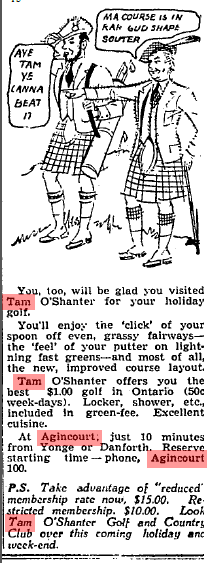
The life of ‘the Tam’ began in 1933 when George Sparkhall, William’s father, purchased a 160-acre cattle farm on the south half of lot 29 concession 3, now the east side of Kennedy Road north of Sheppard Avenue. Using a barn as a clubhouse, Sparkhall turned the lot into a 104-acre pay-as-you-play golf course, calling it ‘Meadowbrook’, presumably referring to the meandering west branch of the Highland Creek situated in its southern end.


Globe & Mail, June 30, 1937


Globe & Mail, July 11, 1938


In the following years, the golf and country club served as social gathering point for the area, hosting banquets, weddings, dances, and other events such as the 1948 Easter party to kick off a $100,000 campaign for a new North Scarboro Memorial Centre.


In 1947, the Tam applied for a dining room and a lounge liquor serving license, under the recently enacted Liquor License Act, 1946. Under the provisions of the new law, residents could protest an application made within their district. A group of Agincourt residents did just that when 400 of them petitioned to oppose the Tam O’Shanter application, explaining that there had never been a need for the sale of beer in the village, the club house was used by teenagers for parties, and as the Tam was located on two major streets, the license would encourage drinking and driving. Owner William Sparkhall answered that the country club was actually outside the district’s borders and the application was only meant to sell beer to members.


Dance at Tam O’Shanter Boys Club, November 15, 1956. Credit: Toronto Archives


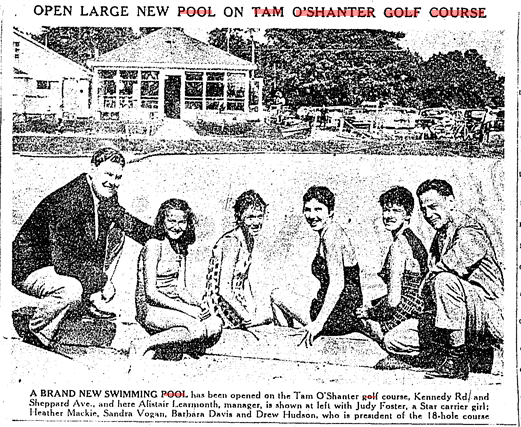
Over the years, the younger Sparkhall, who purchased the golf course from his father in 1938 and renamed it Tam O’Shanter, undertook several upgrades to the property, and added an adjacent lot bordering Birchmount Road. In 1954, the club improved several holes in its 18-hole course, and upgraded its clubhouse and dining room. Two summers later, members and visitors had access to the new and popular Emerald Pool.


Toronto Daily Star July 31, 1956


In 1958, a game-changing addition came in the form of a 12-sheet curling rink. The modernist structure was constructed of fieldstone and housed spectators’ galleries behind three four-sheet sections. It was the “largest in Canada devoted entirely to curling”. The Globe and Mail boasted that even before construction had completed, the club already had a “considerable response to a membership campaign” for new curlers. At this time, the main clubhouse added bowling alleys, two dance floors, two dining areas, and three lounges. Eight more curling sheets followed in 1961. The following year, the Tam could pride itself on “a rink six inches wider than that of Maple Leaf Gardens.” Together, the improvements made the Tam into a formidable and beloved social, sporting, and recreational venue.


Globe & Mail, Feb 26, 1958


While Sparkhall vowed golf would continue as usual after the fire (and indeed it reopened the next day and the following season), most of the club’s functions were severely compromised. A 3-day Oktoberfest scheduled to take place on the Tam grounds that weekend was shortened to a 1-day event at a different venue. Worse, however, the upcoming hockey season was greatly affected by the lack of a rink. The Wexford Hockey Association, whose teams played out of the Tam O’Shanter Arena, scrambled to find other facilities to host its games. North York Mayor Basil Hall elected to bring the matter to Metro Regional Council to see if it could offer assistance in relocating games.


Bruce and Margaret Hyland had to consider their next steps, too. The 5-time Olympic coaches — legendary figures in Canadian skating — ran a popular summer hockey school and the Canada Skating Club at the Tam. The hockey school was one of the largest in the world; Canadian hockey greats Frank and Peter Mahovlich, Kent Douglas, Paul Henderson, and Eddie Shack practiced at Tam O’Shanter Arena. The skating school was supposed to start a day after the fire. By December 1971 though, the Hylands announced initial plans for a $2 million arena built “on four acres of land between Victoria Park Avenue and Don Mills Road, just south of Finch Avenue.” It would be called the Hyland Ice Skating Centre.


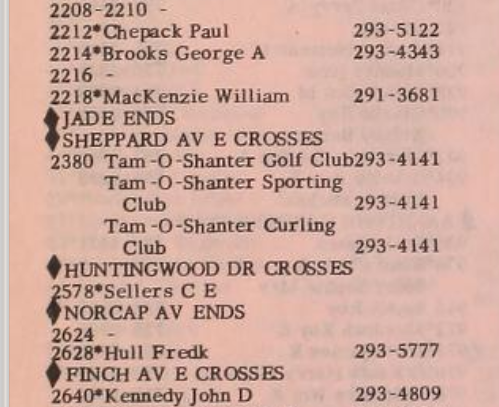
1969 Toronto City Directory of Kennedy Road. Credit: Toronto Public Library.


The club’s 300 curling members elected to remain together, and used membership dues to lease space offered by other clubs in the Toronto area. In June 1972, officials at the Tam-Heather curling club announced they were ready to resume their activities in October of that year. They hoped a new sports complex would be ready by the first anniversary of the fire at Tam O’Shanter.
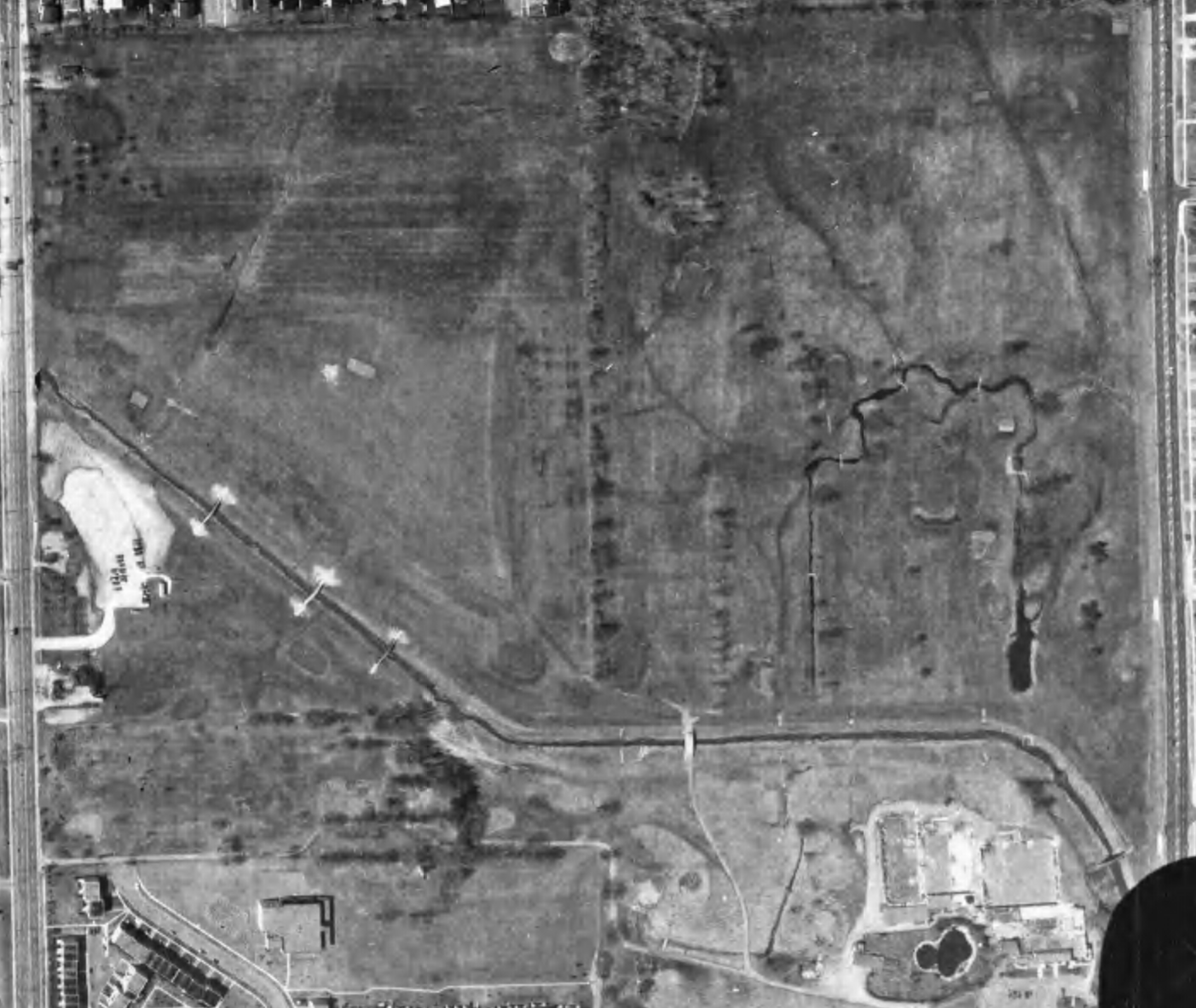
Interestingly, despite William Sparkhall’s declaration to have the recreation centre up and running in 1972, he – under the Tam-Land Estates Ltd. banner – applied shortly after the fire to rezone the 118-acre golf course to accommodate residential and commercial enterprises. The golf course at the time was zoned for agriculture in its western half and recreation in its eastern half. Tam-Land Estates planned to build a housing and high-rise development on the property. Community opposition, led by future Scarborough Controller and Mayor Joyce Trimmer, successfully fought to keep the area as open public space, harnessing the power of Trimmer’s adamant and ultimately effective letter writing campaign.


These debates around the future of the Tam O’Shanter site also coincided with Metro Parks Commissioner Thomas Thompson’s desire to acquire more parkland for Metro Toronto. The events following Hurricane Hazel in 1954 led the Metro Toronto and Region Conservation Authority (MTRCA) to acquire flood valleys that would push Metro’s parkland to nearly 7,000 acres. However, outside of ravine lands, the region was in short supply of recreation lands to service its expected growth. A potential solution was the acquisition and transformation of private golf courses as they became available.


In what the Globe And Mail called “a bold step toward parks’, Metro Parks Committee allotted $5 million dollars in Metro Council’s 1972 budget to acquire the 165-acre York Downs Golf Course in the Bathurst Street and Sheppard Avenue area and the 118-acre Tam O’Shanter Golf Club in Scarborough. The amount was more than double what Metro spent on parkland acquisition in the previous 10 years. A special subcommittee consisting of Metro Chair Albert Campbell, North York Mayor Basil Hall, Scarborough Mayor Robert White, Metro Parks Commissioner T.W. Thompson, and Metro Planning Commissioner Wojctech Wronski also pushed back Sparkhall’s redevelopment proposal indefinitely so that it could study and report on the possibility of acquiring Tam O’Shanter and York Downs.


With news of the Tam’s availability as potential park space, decision-makers and media urged the purchase. As one Toronto Star editorial put it, Metro Council had to “grab the chance for green space”. It argued that Tam O’Shanter was parkland “in a crowded area” and “there was no obvious recreational land coming on the market nearby.” New Metro Chairman Paul Godfrey called the chance “a golden opportunity that won’t come again”. Another positive was it would not require the demolition of any homes, which was notable because Thomas Thompson’s Metro Parks Committee was also recommending the demolition of 254 houses on the Toronto Islands to create more parkland.


With the sub-committee’s final decision to ultimately buy the course, questions in 1973 revolved around who would pay, how they would pay, and how much they would pay. Metro had $3.5 million budgeted for parks for the next five years; if it took a gander on Tam, it could affect its ability to acquire other parks. Scarborough Controller Karl Mallette added that Scarborough taxpayers could “easily afford” a raise on taxes to pay for new parkland and facilities, such as the new park at Tam O’Shanter. In February of that year, Campbell announced a proposal of a three-way agreement which would see the Ontario government cover half the course’s costs and Metro and Scarborough covering a quarter each. The same formula was used to purchase the York Downs Course. An unknown factor was Tam-Land Estates’ asking price, which was reportedly between $12,000 to $100,000 an acre. In September 1973, the price was eventually set at $10.8 million, a number that had East York Mayor Willis Blair suspecting was too rich. However, two different appraisals valued the land at $10.6 million and $11 million.


Aerial view of the Tam O’Shanter Golf Course, 1975. Bridges that formerly crossed the West Highland Creek were removed, possibly as the course was awaiting reorganization.


Meanwhile, the Tam’s curling club and hockey and skating schools happily found new homes. Boasting a membership of 540 and set to reach capacity of 640 by the start of the following season, the Tam-Heather Curling Club opened its new eight-sheet, $500,000 complex in March 1973 at Morningside Avenue and Highway 401. Also in 1973, Bruce and Margaret Hyland successfully opened Metropolitan Ice Skating School (later Centre Ice) on Victoria Park Avenue. The complex had three ice surfaces, one of which Mr. Hyland operated a hockey school.


Finally, two years after the fire that devastated the Tam, officials met in Metro Chairman Paul Godfrey’s office to formalize the purchase of Tam O’Shanter Golf Club. On November 10, 1973, William Sparkhall, president of Tam Land Estates, accepted two cheques totalling $10,825,000 for the 118-acre golf course from Godfrey, Education Minister Thomas Wells, Scarborough Mayor Paul Cosgrove, and Fred Wade, chairman of the MTRCA. Tam-Land Estates retained some land for its own redevelopment purposes. With the purchase of Tam and York Downs, Metro Parks also recommended the creation of an inventory of other private courses with the goal of purchasing them in the future. The MTRCA would officially own Tam O’Shanter, but Metro Parks would oversee it.


Following the acquisition, several outlying details remained about the function and form of the new Tam O’Shanter. Scarborough Council disagreed with Metro about the property’s apparent decided future as a municipal golf course. The borough understood that the option was open for it to become a park, and even though discussions during negotiations mentioned that Tam O’Shanter could either continue as a golf course or become a park or a mixture of the two, there was no formal resolution. Wells, the Progressive Conservative representative of Scarborough North, the provincial riding housing Tam O’Shanter, asserted in a February 1973 edition of the Globe and Mail, “It is essential that this site be retained as open space but not necessarily as an 18-hole golf course.” Despite the disagreement, new Metro Committee Parks Commissioner Robert Bundy said the site was “well located for a golf course” and Tam O’Shanter remained a public course – possibly because it was one of the only courses in the east end of Metro Toronto.
The golf course required major upgrades, however. While minor improvements kept the golf club operational through the 1970s, the quality of the greens, which required a new irrigation system, was so poor that Metro Parks lowered its fees in 1975 by 50 cents. With the damage to and the eventual demolition of the old Tam complex in the years after the purchase, the course also required a new clubhouse. In the first half of the 1980s, Tam O’Shanter underwent $800,000 worth of upgrades to update and reconfigure its course with a new entrance of Birchmount Road. Its new clubhouse opened on May 7, 1982.


Aerial, 1983. Credit: City of Toronto Archives


In 1985, Sparkhall and Co. – seemingly the new banner of Tam-Lands Estates Limited – looked to redevelop the land south of the course and north of Agincourt Mall. It proposed, and was allowed to build “1000 apartments, 23,225 square metres (250,000 square feet) of offices, up to 6,040 metres (65,000 square feet) of commercial use, libraries, day nursey, and educational facilities on 6.16 hectares (15.23 acres) of land on Kennedy north of Bonis [Avenue].”
Just as there had been opposition in 1971, residents of Bonis Avenue mobilized to fight the proposal. The community assembled a petition of 500 names and packed the Scarborough Council chambers in March 1985 to voice disapproval of their neighbourhood becoming “a mini-downtown.” Along with the scale of the development, another sticking point was the proposed extension of Bonis, which was at the time a dead-end street running east from Birchmount Road, stopping at the old lot border. The plan called for its lengthening to connect with Cardwell Avenue at Kennedy Road. Residents, including Controller Joyce Trimmer (who beat out former Controller Karl Malette in the 1974 election), argued that the street would only serve as a high-speed detour for Sheppard Avenue traffic. After more consultations, the project did not go through.


Plans for development along Bonis Avenue surfaced again in 1988, this time spearheaded by Tridel Corporation. The new proposal involved “four 24-storey condo towers with a total of 1,112 units, a five-story building with 7,961 square metres of office space, a one-story building with 5,580 square metres of retail space, and two-storey, 1953-square metre public library.” The inclusion of a library was notable because a 1977 plan suggested the erection of a much-needed district library on a portion of the Tam O’Shanter property turned over to Scarborough for municipal parkland. This was opposed by Trimmer and was ultimately nixed by Metro planners.
Despite being a slightly more scaled back version of the Sparkhall and Co. project, Tridel Corp. faced similar challenges and objections as its predecessor. As was the case three years ago, the property, zoned for institutional and recreational use, would have to be rezoned. Planning and traffic studies again recommended an extension of Bonis Avenue. Opponents said the development had double the amount of allowed units. The Highland Heights Community Association warned the street would become a ‘traffic nightmare’, which would bring in 1,000 cars in the evening rush hour (Tridel contended 335 cars). Even with the opposition, calls for the developer to scrap the project largely went unheard.


In October 1988, despite last minute objections, Scarborough council approved the $500-million dollar project behind Agincourt Mall. It was the second major condo project approved in the span of a month in the borough. On September 6, Council approved $1.5 billion, 2,420-unit development – also by Tridel – at the Scarborough Civic Centre.


As a part of the Agincourt deal, Scarborough also received a 1,200-square-metre parcel of land worth more than $300,000 for a $4.5 million library. Tridel also gifted $500,000 for its construction as well as $1.6 million for day care, park development and landscaping. The new Agincourt Library branch opened in 1991 on Bonis, moving from Agincourt Mall and continuing a legacy dating back to 1918.


Also in 1991, ‘The Greens at Tam O’Shanter’, the first tower in the phased project, opened. Described by a 1989 Toronto Star ad as “a magnificent collection of country club style residences overlooking the manicured greens and fairways of the renowned Tam O’Shanter Golf course in Scarborough”, it is a 24-storey construction with “211 one, two and three bedroom suites – many of which open up onto private terraces” which “range from 787 square feet to 1,782 square feet. Its marketing harnessed “the royal and ancient” tradition of golf as it was played on old Scottish courses like St. Andrews and Leith Links, when the game “was the sport of kings”. Although it did not do so in the end, the advertisement could have also referenced the 50+ year history of golf at Tam O’Shanter.


Toronto Star, Oct 7, 1989


The next parts of the Tridel complex – 28 brownstone townhouses and 3 more 24-storey condos – would open over the next twenty years. One of the condos – 1998’s “The Highlands at Tam O’Shanter” at 228 Bonis Avenue – roughly occupies the former site of the Tam’s famed clubhouse and recreation centre.


Today, the Tam O’Shanter Golf Clube operates an 18-hole, Par 72 course from mid-April to mid-November.

Agincourt’s Brookside: From Farm to Subdivision

A curious item in the Toronto Public Library’s Digital Archive is an image of farm or ranch located in Agincourt. The picturesque scene is “Brookside”, the estate of the Pattersons, located on the northeast lot of the intersection of Kennedy Road and Sheppard Avenue. The evolution of this property is an interesting story.

Paterson, “Brookside”, Sheppard Ave. E., n.e. lot Kennedy Road, 1905. Credit: Toronto Public Library.

The Paterson family of Scarborough had three lots on the east side of Kennedy Road (lot 28) between Sheppard Avenue (Concession III) and Finch Avenue (Concession IV) in Agincourt, together totaling 200 acres. The middle Paterson lot was “Elmridge“, whose farmhouse still exists today.

Illustrated Atlas of York County, 1878. Credit: Historical Maps of Toronto.

The Globe, January 7, 1914. Credit: Globe and Mail Archives.

The 67-acre Brookside was the southern most of these lots running a third of the way to Finch Avenue and edging on the Canadian National Railway. It was opposite the future Tam O’Shanter Golf Club. The West Highland Creek ran through the property, likely giving the estate its name.

Map of the Townships, York, Scarboro, and Etobicoke, 1916. Credit: University of Toronto Map & Data Library.

The Globe, September 24, 1926. Credit: Globe and Mail Archives.

Brookside existed in a rural setting for much of its life, until the second half of the 20th century. By 1950, streets and houses popped up to the east, north, and south of the farm buildings, likely as parts of the Paterson lot was partitioned.

Aerial photo, 1950. Credit: City of Toronto Archives.

Aerial photo, 1953. Credit: City of Toronto Archives.

By the mid-1950s, the streets took their shape and names. Running north to south was Patterson Avenue to honour the family whose farm it was built upon. Running east to west was Station Rd (leading to the CN Station, now a GO Transit Station), Marilyn Avenue, and a tiny Reidmount Avenue. The woodlot behind the farmhouse also seemed to have been cleared.

Map of Metropolitan Toronto, 1955. Credit: University of Toronto Map & Data Library.

Aerial photo, 1956. Credit: City of Toronto Archives.

By the end of the decade, changes were afoot. Patterson Avenue was renamed to an extended Reidmount Avenue and Station Road became Dowry Avenue. (As an aside, on the other side of railroad tracks, First Avenue became Agincourt Drive in 1957. The changes likely resulted from the reworking of the road network following the creation of Metropolitan Toronto.)

The image below is a Planning Map from the 1959 Official Plan of Toronto. The Brookside Farm is labelled as “R.E.” potentially meaning “Residential Estate” or “Rural Estate” or even “Residential Expansion”, which in any case references a larger lot. “R” is “residential” and “C” is “commercial”. The corresponding aerial image provides a visual of the lot division.

Scarborough: streets and names, 1959. Credit: York University Map Library.

Aerial photo, 1959. Credit: City of Toronto Archives.

By 1969, the Paterson farm buildings have completely disappeared. Moreover, the West Highland Creek was channelized and widened along with a new bridge running over Kennedy Road.

Aerial photo, 1969. Credit: City of Toronto Archives.

West Highland Creek looking southeast towards Cardwell Avenue.

By the middle of the 1980s, the area around Kennedy and Sheppard was increasingly built up. A new street named Cardwell Avenue now connected Kennedy and Dowry Street. On either side of Cardwell was a new subdivision of houses.

Aerial photo, 1985. Credit: City of Toronto Archives.

Cardwell Avenue east of Kennedy Road

Today, this group of homes are part of the modern geography of Agincourt. If one looks closer though, the shape of the overall subdivision corresponds to the Patersons’ farm Brookside that was once there.

Google Maps, 2021