Two Amazing Rooftop Views of Toronto’s The Ward


In the early 1900s, St. John’s Ward or familiarly just ‘The Ward’ was a dense, immigrant enclave in the central core of the City of Toronto. The neighbourhood was roughly bound by Queen Street, College Street, Yonge Street, and University Avenue, and housed some of the city’s first Black, Jewish, Chinese, Irish, and Italian colonies. Two early 20th-century rooftop photos provide interesting overhead views of the physical makeup of the district.

The first rooftop view was taken in 1920 by iconic Toronto photographer William James from the top of the Alexandra Palace Apartments, formerly located at 184 University Avenue opposite the terminus of Gerrard Street West on the edge of The Ward.

The southeasterly scene below and far beyond the Alexandra Palace Apartments is fascinating. In the foreground is a great visualization of University Avenue’s history as two separate streets. Among the recognizable landmarks are Old City Hall and the T. Eaton Co. factory complex in the background (more on this further down), the Hester How School at centre-left, the Presto-O-Lite factory and the Toronto House of Industry at centre, and the African Methodist Episcopal Church, First Baptist Church, and Maclean Publishing Co factories at centre-right. Interspersed is a dense grid of low-rise housing and other structures which ultimately came to define The Ward.

Looking southeast from University Avenue, 1920. Source: City of Toronto Archives. Annotations by Bob Georgiou.

There was another photograph also taken by James from the Alexandra Apartments, this one dated to “circa 1920”. Although generally quite similar, noticeable differences exist between this and the 1920 photo, most visibly that the latter is a much broader view of the same general area of The Ward.

Looking southeast from University Avenue, c 1920. Source: City of Toronto Archives.

While the date of the zoomed-in image is approximate, it almost certainly precedes 1920. The main differences between this and the 1920 photo is the lack of the Prest-O-Lite Factory (built 1917) and the northernmost Eaton’s factories (also built 1917). The most important detail, however, is the Eaton’s Annex building, which appears under construction. The store opened in 1913, which likely dates the image to 1912 or 1913.

The Alexandra Palace Apartments (also simply called the ‘Alexandra Apartments’, ‘The Alexandra Palace’, or ‘The Palace’) was a 7-storey, luxury apartment building constructed in 1904 during Toronto’s first apartment building boom, meaning it was one of the first of its kind in the city. The architect was the prolific George W. Gouinlock, who also designed the Temple Building. Famous residents included tycoon E.P. Taylor and Ontario Hydro founder Sir Adam Beck (the old Ontario Hydro Headquarters was directly north of the apartment). It is said that residents moved into the Palace to retire.

Alexandra Palace Apartments, No. 184-188 University Avenue (erected 1909), 1919. Source: City of Toronto Archives.

In the 1920s, the Palace went from apartment house to apartment hotel with a dining room already in its offerings. In the 1940s, the building was slated to become a nurses’ residence for Sick Children’s Hospital. By the 1950s, the building ceased to be a residence and was heavily remodelled to be a modern office building, losing much of its original exterior features. In 1968, the Alexandra Apartments building was demolished.

Postcard of The Alexandra, Queen’s Park Avenue, Toronto, Canada’s Finest Apartment House, 1910. Source: Toronto Public Library.
Alexandra Apartments, University Avenue, west side, between Elm & Orde Streets, 1954. Source: Toronto Public Library.

The second rooftop photograph comes from the top of an Eaton’s factory tower once located adjacent to the Church of the Holy Trinity. Like the Alexandra Apartments picture, it was taken by William James. It is dated “circa 1910.”

The view is looking northwesterly over The Ward and has several common landmarks with the 1920 Alexandra Apartments image, such as Toronto House of Industry, the Hester How School, and the Grace Church. In the foreground along Bay Street (at the time called Terauley Street) and Dundas Street (Agnes Street) are the Terauley Street Synagogue, the Lyric Yiddish Theatre, and Police Station #2 (which appears to have officers in its yard). As with The Palace image, there are also the tightly packed streets of tiny residences, many undoubtedly housing men and women who were employed by Eaton’s. Finally, the distinctive rooflines of Queen’s Park and Toronto General Hospital loom far in the distance (with the Alexandra Apartments somewhere nearby).

Looking north from top of Eaton’s factory, c 1910. Source: City of Toronto Archives. Annotations by Bob Georgiou.

The Eaton’s factory itself where James captured the image was a 12-storey structure located adjacent to the Church of The Holy Trinity. It was built around 1910 in a period when the Eaton’s footprint in the area expanded from a single store at 190 Yonge Street in 1883 to encompass at least half the block between Yonge, Bay, Queen and Dundas Streets by 1920. The factory was demolished in the 1970s when other Eaton’s factories and warehouses were razed in part to make way for the Eaton Centre (The Eaton’s Annex store referenced earlier was destroyed by fire in 1977).

T. Eaton Company factory from Louisa Street, 1910. Source: City of Toronto Archives.
The Eaton’s store, the Eaton’s Annex, mail order facilities and factories in Toronto, at Yonge and Queen Streets, in 1920. Source: Wikimedia Commons.

The Eaton’s image is dated “circa 1910”, which is likely accurate as it is very comparable to the “circa 1920, but likely 1912-3” Alexandra Apartments photo. The Prest-O-Lite factory does not appear in the image, thus 1910-1917 is a fair timeframe.

T. Eaton factory from Louisa Street, c 1920. Note the addition of the north tower (1920). Source: City of Toronto Archives.

Today, if the two William James rooftop photos were recreated, they would be taken from Mount Sanai Hospital and the Bell Trinity Square office building, respectively. Ironically, the Alexandra Apartments and the Eaton’s factory were both constructed and demolished in similar periods: the 1900s to 1910s and 1960s to 1970s. The dwellings, houses of worship, and businesses of The Ward also largely disappeared by the 1950s as lands were expropriated for various projects. The district continued to change since then until the present-day, making these century-old views a far cry to today’s world.

A modern view of the area formerly known as The Ward, 2021. The sites of The Alexandra Apartments and Eaton’s factory are circled. Source: Google Maps.

“The Ward: Representations and Realities, 1890-1950” at Campbell House Museum

I was first introduced to The Ward several years ago through a compelling archival photograph. It was of an impoverished child standing in the debris-filled lane of what looked like a ‘slum’. In the background were the unmistakable Romanesque Revival towers of Old City Hall. The disparity between the two places – the majestic civic heart of the city and the desperate ‘ghetto’ literally at its doorstep – struck me at the time. And it still does. Even more striking is that photo was taken in what is now the southern end of Nathan Phillips Square.

Rear of 21 Elizabeth Street 1913
Rear of 21 Elizabeth Street, The Ward, 1913. Source: City of Toronto Archives.

The story of St. John’s Ward is very much one of lost geographies (like in the photo), lost narratives, and how and why we remember or don’t remember. The Ward’s former borders were from Yonge to University and College to Queen. Those streets still exist of course, but the built form between them largely hasn’t survived. For a long time, the stories associated with those landmarks and their Chinese, Italian, Jewish, and Black communities also went underground.

The 2015 release of The Ward: The Life And Loss of Toronto’s First Immigrant Neighbourhood was an excellent step in revealing those narratives. The book was co-edited by John Lorinc, Ellen Scheinberg, Michael McClellan, and Tatum Taylor, and features the great contributions of many talented writers. It is easily one of my favourite titles in the Toronto History genre. Today, “The Ward: Representations and Realities, 1890 – 1950” continues that work.

The Ward Toronto

Part of the Myseum of Toronto’s 2015 “Intersections” festival,  “The Ward” exhibition is housed in Campbell House Museum, the 1822 residence of Sir William Campbell, a former Chief Justice of Upper Canada. In 1972, the Georgian-style house famously moved from its original location on Adelaide Street to Queen and University.

Cambell House Museum Toronto

It’s a fitting locale given the museum’s placement near the historic area of The Ward (and indeed, above the mantle of the ballroom is an aerial photograph of the neighbourhood taken from the location of the museum.)

Cambell House Museum The Ward 2

The challenge of interpreting and showcasing The Ward’s histories is the lack of contemporary borders attached to those stories. Thus, from a museological perspective, it affects the kinds of artefacts one has access to. Photos of The Ward are abundant, so the curators –  Paul Bishop, Daniel Panneton & Marisa Strom – had no issues there. Photographer Arthur Goss, at the instruction of the health department of the day, did a remarkable job of documenting the troubling conditions of the enclave.

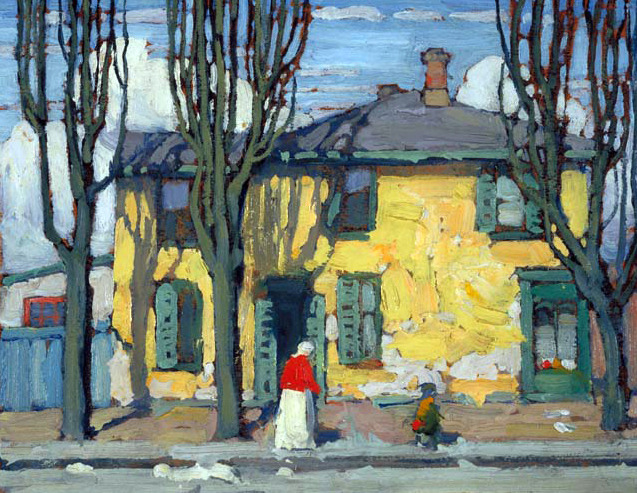
The show is organized thematically with well-displayed panels and pictures about The Ward’s politics, labour strife, Lawren Harris’ artistic take on the area, and other realities. New to me was Albert Lane was one of Toronto’s notorious laneways.

Cambell House Museum The Ward 3         Cambell House Museum The Ward 5

Cambell House Museum The Ward 4
A nice collection of loaned artefacts offer some physical connections to The Ward. They include a labour union banner, restaurant items and Eaton’s pins, and a copy of the (in)famous 1911 Hastings Report in which Toronto’s medical officer of health, Dr. Charles Hastings, observed and critiqued the overcrowded, ‘diseased’ conditions of the enclave. Slums were not a good look for Toronto, according to the high-ranking civil servant. The report came to be the official representation of The Ward.

Cambell House Museum The Ward 7

Cambell House Museum The Ward 8

The neatest addition for me, though, was the collection of oral histories from surviving members of the neighbourhood. “The Voices of The Ward” offer different realities than the Hastings Report — one that emphasizes its deep community. Stories include the ethnically diverse clientele of its shops, being an Italian during the War, and how Eaton’s would not hire Italians.

The interviews provide an audible, human element to The Ward in a way that faces in pictures or names in old news articles cannot. Archival images and words are certainly great resources, but they can put history at a distance. The recordings are a very important reminder that there are living connections to St. John’s Ward today. After all, 1950 wasn’t that long ago in the grand scheme of history. Residents of The Ward and their descendants still live in Toronto.

Cambell House Museum The Ward 9
“The Ward: Representations and Realities, 1890-1950” is on until April 23, 2016 at Campbell House Museum at 160 Queen Street West. Admission is free, although donation is always appreciated.

Cambell House Museum The Ward 1